Author Archive

What’s in a brand?

Monday, July 19th, 2021

Creating the new brand and logo for Bioprotection Aotearoa was a collaborative effort, involving many different people with many different roles in the new Centre of Research Excellence.

It started with a one-day branding workshop involving researchers, directors, kāhui, and admin team members, from which we created a kaupapa positioning strategy. We then briefed a designer.

Designer Kim Hickford produced three alternatives, each emphasising a different aspect of Bioprotection Aotearoa’s kaupapa.

The logo we chose, with significant input from our Co-Chair Henare Edwards and the kāhui, is based on the three pou, or pillars of key research for Bioprotection Aotearoa. Each pou is a stylised koru shape to represent growth and strength. The three pou stand proudly, almost like people or sentinels, each one gaining strength from its neighbour, quietly guarding the environment.

The curve stretching across the bottom represents the foundation of the whare, Papatūānuku, mother Earth.

Our logo encapsulates the essence of Bioprotection Aotearoa – working collaboratively to tackle the bioprotection challenges we face and protect our environment.

What is Bioprotection Aotearoa?

Monday, July 19th, 2021

Bioprotection Aotearoa is a new Centre of Research Excellence, built on the whakapapa of the Bio-Protection Research Centre. However, it is not a simple continuation – it is an evolution.

Bioprotection Aotearoa adopts a new approach to bioprotection research in Aotearoa New Zealand. Excellent science is still at its core, but the way of doing that science is more inclusive and holistic. It is guided by a Māori values framework – Taiao – to protect our productive landscapes from pathogens, pests, and weeds.

Our research is structured around three pou, or pillars, which support the whare of our research.

Pou titirangi – piercer of the heavens

The first pou guides our research to DEFINE a healthy, productive ecosystem. It is led by Prof Jason Tylianakis (University of Canterbury) and Dr Julie Deslippe (Victoria University of Wellington).

The three projects in this pou cover integrated measurement of healthy ecosystems, processes that promote productive ecosystems, and a new framework to assess ecosystem health in Aotearoa New Zealand.

Pou tokomanawa – the heartbeat of the whare

The second pou guides our research to DEFEND against pathogens, pests, weeds, under a changing climate. It is led by Dr Monica Gerth (Victoria University of Wellington) and Prof Matt Templeton (Plant & Food Research, University of Auckland).

There are four projects in this pou, covering the mechanisms of microbiota-mediated protection against plant pathogens, genetic and genomic approaches to controlling plant pathogens and insect pests, and exploring the molecular basis of pathogen host specificity.

Pou nuku-a-rangi – shifting throughout the heavens

The third pou guides our research to DESIGN ecosystems that are more resilient and resistant. It is led by Dr Steve Wakelin (Scion) and Assoc Prof Amanda Black (Lincoln University).

The three projects in this pou cover creating healthy, disease-resistant and climate-resilient soils, designing future forestry, and creating effective socioeconomic and governance models that lead to resilient ecosystems.

Another research theme extends across all pou and supports them: recloaking Papatūānuku. This is an indigenous socio-ecological restoration model using mānuka and kānuka to promote native biodiversity and restore our whenua.

It aims to define the links between humanity and the natural world, resolve the value of mauri across ecosystems, and show how ecosystem restoration underpins community wellbeing. It is led by Prof Nick Roskruge (Massey University) and Dr Nick Waipara (Plant & Food Research, University of Auckland).

“Bioprotection Aotearoa is doing exactly what a Centre of Research Excellence should do,” says Co-Director Travis Glare. “We are bringing together a national team of experts, to push the boundaries of science and train the next generation of leaders in the field.”

Fellow Co-Director Amanda Black says she is very excited to be leading a CoRE of talented people to carry out the kind of research that Aotearoa New Zealand needs. “I’m hoping we will grow together as a team to achieve our desired outcomes and impacts – the main one being healthy productive landscapes guided by Te Ao Māori values.”

Indigenous fungus may help to control wilding pines

Wednesday, June 16th, 2021

An indigenous New Zealand fungus may help to control wilding pines – one of the country’s most ecologically damaging weed species – a student’s research project shows.

​Wilding pine control costs New Zealand millions of dollars a year, and involves the costly and time-consuming methods of cutting down the trees and spraying herbicide from the air. Control seldom totally eradicates the pines, which often reinvade sites some years later.
Armillaria novae-zealandiae, also known by Māori as harore, is a fungus that feeds on decaying wood. It is common in native forests, where it is a natural part of the ecosystem, helping to decay fallen trees. But if it gets into pine plantations it is seriously destructive, killing seedlings and reducing growth.

In a Bio-Protection Research Centre student research programme, biology student Genevieve Early, investigated how well A. novae-zealandiae and two closely related species established on wilding pine species.

Supervised by BPRC principal investigator and University of Canterbury Professor Ian Dickie and his colleague Dr John Pirker, she tested what age of wood it grew best on (ranging from live and freshly harvested wood to old and decayed wood).

“The research aimed to address knowledge gaps in our understanding of Amillaria, and eventually investigate whether we could use it as a biological control of invasive pines,” says Genevieve.

“Some of the questions we have about using it, for example, are whether we can introduce it to grassland areas that are susceptible to wilding pine invasions, where it doesn’t currently exist, and whether introducing it at the same time as pines are felled would prevent reinvasion.”

Her results were promising. “Armillaria novae-zelandiae showed the best growth,” she says. “We tested several isolates of this species and all of them grew larger than the other Armillaria species. It also consistently grew most vigorously on live or freshly-felled pine wood.”

Armillaria’s strong growth on live or fresh pine wood is important,” Genevieve says. “It’s really promising that all the fungi grew best on live or fresh wood, as this implies that we could potentially design a way to inoculate wilding pine sites with Armillaria at the same time we are manually clearing trees and using herbicide. That could be practical and economical if we don’t have to plan more site visits to use the fungi.

“We also want to find out if this will accelerate decomposition and reduce wildfire risks.”

Genevieve said A. novae-zelandiae has been used as a food source by Māori, who should be involved in continuing research. “Using it as a biological control may be of particular interest to iwi in areas badly affected by wilding pines, as a way of protecting landscapes and ecosystem values.”

Prof Dickie said his group was seeking funding to continue the research, particularly looking at how Armillaria affected native seedlings, to test whether it could be used to clear pines in areas where ecological restoration was planned.

“Until now, we’ve been good at killing pines, but not at restoring ecosystems,” says Ian. “We are winning the battles, but losing the war. This fungus may be the key to not just killing pine, but to keeping it from reinvading, and to restoring ecosystems.”

You can view a video of Genevieve Early presenting her research here.

Native plants may be weapon against soil contamination

Wednesday, June 16th, 2021

New Zealand’s native plants may help to reduce bacterial contamination caused by dairy effluent, a new study suggests.

​Researchers from the Bio-Protection Research Centre, ESR, and the University of Canterbury have shown northern rātā (Metrosideros robusta) and swamp mānuka (Leptospermum scoparium) can reduce the amount of Escherichia coli (E. coli) in soil by 90%, compared with ryegrass (Lolium perenne), and in less than one-third of the time. They worked in partnership with Ngaa Muka Development Trust and Matahuru Marae in Waikato.

The research, published in Applied Soil Ecology, aimed to investigate the antimicrobial properties of New Zealand native plant extracts and test if they were effective in soil.

First they tested leaf extracts of 12 plants, chosen because they were either medicinal plants, poisonous, or had a strong scent. These included harakeke (Phormium tenax), golden ake ake (Olearia paniculata), mānuka (Leptospermum scoparium), kawakawa (Piper excelsum), koromiko (Veronica stricta), ngaio (Myporum laetum), golden Spaniard (Aciphylla aurea), Spaniard (Aciphylla sublabellata), and horopito (Pseudowintera colorata), as well as swamp mānuka and northern rātā.

Swamp mānuka, northern rātā, and horopito showed antimicrobial properties, and so they were tested to see if they reduced bacterial contamination in soil.

The scientists grew seedlings in pots, and, once the seedlings were large enough, added equal amounts of dairy shed effluent to each pot. They watered the pots to simulate rainfall, and then tested for E. coli on days 1, 3, 7, 14, and 21.

Results indicated the amount of E. coli in the soil would reduce by 90% by day 14 in the pots containing swamp mānuka and northern rātā. “Extrapolation from L. perenne data indicated that this reduction would happen by day 45.”

The roots of swamp mānuka and northern rātā both increase soil acidity, which researchers suggest may have caused the faster E. coli die-off.

E. coli tends to do better in soil that is alkaline to neutral pH,” said Dr Hossein Alizadeh, of the Bio-Protection Research Centre. “The roots of swamp mānuka and northern rātā change soil to make it more acidic, so that may be why E.coli dies off more quickly.”

However, the researchers did sound a note of caution. When soil was already saturated, irrigating it with dairy shed effluent resulted in E. coli leaching out of the soil very quickly before any plants could dilute or destroy it. This suggested that “high irrigation regimes” could result in more environmental contamination.

The authors say their results show the need for further field research.

“Future research in field conditions would show the potential and/or limitations of bioactive plantings for preventing faecal or microbial contamination of freshwater resources from contaminated soil.”

Full paper: Phytoremediation of microbial contamination in soil by New Zealand native plants, https://doi.org/10.1016/j.apsoil.2021.104040

Image: Gerald.w, CC BY-SA 3.0​ via Wikimedia Commons​​

Study challenges assumptions on why exotic plants thrive

Tuesday, June 15th, 2021

​Invasion ecology has long suggested exotic species can become successful by escaping their natural enemies. A long-running Bio-Protection Research Centre experiment challenges this, showing that exotic plants dominate their communities, despite accumulating and sharing herbivores more than co-occurring native plants.

The Enemy Release Hypothesis predicts that exotic plants become successful because they escape from natural enemies, compared with native species. However, studies testing whether exotic species escape (known as community enemy release) or attract (biotic resistance) natural enemies have produced mixed results.

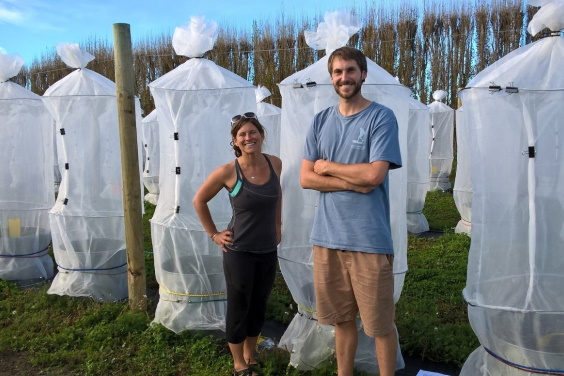
We set out to test whether plant-herbivore interactions systematically favour exotic plants. We established 160 experimental plant communities, each containing eight plant species selected from a pool of 39 (19 natives, 20 exotics) that co-occur in Aotearoa New Zealand grasslands. We added 20 species of invertebrate herbivores to half the pots, all of which were enclosed in 2.2 m tall mesh cages. The herbivores were a mixture of seven native and 13 exotic species, including New Zealand grass grub (Costelytra giveni), three species of leafroller caterpillar, several exotic aphid species, and the native grasshopper Paprides nitidus. Most of the herbivores were polyphagous, meaning they feed on several hosts.

Setting up this experiment was a massive logistical exercise. We literally applied New Zealand’s ‘no. 8 wire’ approach, using more than 1 km of the eponymous fencing material to support the cages, and 4 km of thread to sew them all together. All of this work required a small army of helpers, including graduate and undergraduate students, support staff, and friends and family.

We surveyed plants for herbivores eight times during the one-year experiment, counting the number of individuals of each species we saw feeding on each plant and calculating their dry biomass. For species that were highly mobile or lived below ground, we extracted DNA from herbivore regurgitate (vomit) and frass (faeces) samples, and used a molecular technique named restriction fragment length polymorphism (RFLP) to identify the host plant.

Not what we expected

The results surprised us: rather than exotic plants suffering less herbivory than their native neighbours, they supported higher native and exotic herbivore diversity and biomass, and were more damaged. We also took the crucial step of measuring how herbivory affected plant performance, finding that exotic plant biomass was 30% lower in mesocosms with herbivores than those without herbivores, while the biomass of native plants was unaffected.

Despite suffering such strong herbivory, exotic plants consistently dominated the biomass of mesocosm communities, potentially because of their indirect interactions with neighbouring plants. Many herbivores that attacked the exotic plants also fed on other species, indicating that exotic plants may be successful because they support polyphagous herbivores that affect neighbouring plants. However, we found no evidence that these indirect interactions affected neighbours’ biomass. Therefore, it is likely that the exotic plants’ faster growth rates simply allowed them to overcome the high levels of herbivory and still dominate the communities.

Our study represents one of the most comprehensive tests of community enemy release and biotic resistance to date. We conclude that polyphagous invertebrate herbivores are unlikely to play significant direct or indirect roles in mediating plant invasions, especially for fast-growing exotic plants. You can read the full paper in Nature Communications.