
 Home
Home19 November 2025
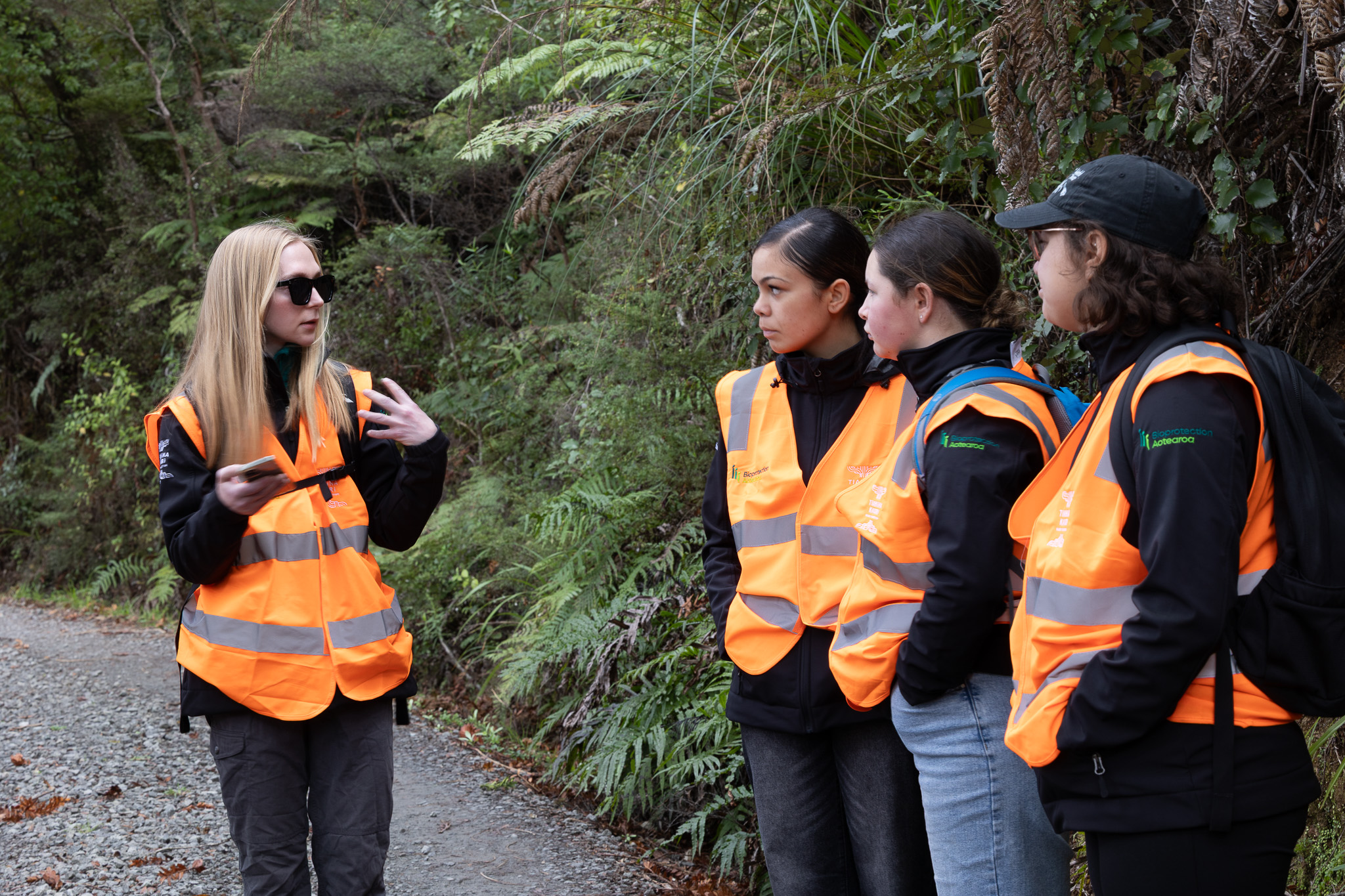
Dr. Alexa Byers (far left) is setting off to explore new research opportunities and become a part of new communities.
In early December, we will be saying goodbye to Alexa Byers, long-time member of Bioprotection Aotearoa and its predecessor, the Bio Protection Research Centre (BPRC). We caught up with Alexa ahead of her departure, and here’s what she had to say about the eight years she’s been with us.
Alexa first arrived in Aotearoa in 2017 to do her PhD.
“I was doing my Masters in the UK, and I saw a PhD advert online to work in kauri. I didn’t know much about kauri dieback, or anything really about New Zealand, but I was looking for a completely new opportunity, and it seemed like a cool thing to do.”
Alexa’s PhD focused on how the kauri soil microbiome responds to and influences the expression of kauri dieback disease, caused by the pathogenic oomycete Phytophthora agathidicida.
“It was a combination of field surveys looking at the response of the microbiome to the spread of the pathogen, and there was also a biocontrol discovery element.”
For this, Alexa screened fungi and bacteria that she isolated from soil against P. agathidicida to try and identify any that would inhibit its growth.
“Often findings in PhDs are quite modest because you’re just learning so much, but I did manage to find antagonists that inhibited the pathogen.”
Her study was also one of the first to use next-generation sequencing to explore the kauri soil microbiome.
“There’s been lots of brilliant work done on it since, but my study was one of the first to use that approach in this context.”
After her PhD, Alexa stayed on with BA as a post-doctoral researcher, where she split her time between two projects.
“I continued to work in kauri forests, looking at soil ecology and soil health. My goal was to quantify the resilience of the ecosystem to disturbances, including disease but also fragmentation, biodiversity loss, and a range of other environmental pressures. For the second project, I’ve been looking at soil carbon and resilience in agri-ecosystems.”
Alexa says her favourite part about doing research within the BA whānau has been the strong emphasis on community.
“When I would feel a bit lost with my research, it would always come back to what was important to communities, especially Māori communities, and what they wanted to know. That was very grounding, and also led to amazing, unique experiences, like from doing soil sampling from Tāne Mahuta up in Northland. I never imagined I’d ever experience that.”
In December, Alexa moves back to the UK. She’ll be following her passion for research by joining the University of Aberdeen as a research fellow. There, she will be exploring biological nitrification inhibition in rice.
“Nitrogen loss in soil is a big problem. One solution might be using microbes to improve biological nitrification inhibition, which could help soils retain their nitrogen.”
Alexa is excited to try out research that is more applied.
“Much of what I’ve done so far has been to explore underexplored environments with more of an ecology or blue-sky focus. With this new research, there is a single problem that we’re trying to solve.”
She is also looking forward to a fresh start and navigating unfamiliar research.
“I just love research, and I love exploring new research areas. I’ll be learning new things and picking up skills, that’s the type of thing I’m looking for right now.”
Alexa insists that her decision to leave is no reflection on New Zealand.
“I’ve come to absolutely adore living in New Zealand,” she says. “There happens to be a wider range of opportunities overseas at the minute, and I want to make the most of that before hopefully return to New Zealand one day.”
More Information
- Research | Enhancing resilience of soil carbon across agricultural landscapes
Discover Alexa’s research into quantifying the impacts of land use change on soil carbon cycling across agricultural landscapes.
Find out more about this project >>
Alexa also co-led research within Pou Nuku-a-rangi, Farming for Resilience. This investigates how land use change shapes soil carbon cycling across agricultural landscapes.
Find out more about this project >>