
 Home
Home26 August 2025

Fionnuala (Finn) Bulman capturing plant responses up close as she monitors maize in the controlled environment of the biotron.
We’d like to congratulate Fionnuala (Finn) Bulman on handing in her PhD! She’ll be spending the winter working (and skiing!) before looking for ways to apply what she learned in her PhD. We caught up with Finn virtually from the noisy café of a ski field.
“I was thinking it would be quiet being a weekday, but obviously its school holidays, so not so quiet,” says Finn.
Finn’s two loves are science and the outdoors. But as much as she loves science, a PhD isn’t something she ever planned to do.
“My Bachelor’s and Master’s focused on medical microbiology,” says Finn. “Then about halfway through my Master’s, I had a realisation that I didn’t really want a job doing research in a biomedical lab or in a hospital.”
Instead, Finn craved a work environment that got her outside. After finishing her Master’s, she was looking forward to traveling overseas while considering her next steps. Then COVID-19 struck, which kept her in New Zealand.
Knowing that environmental science could be a good way to blend her interest in science with her interest in nature, she reached out to universities in the Canterbury region about postgraduate courses in environmental microbiology. She connected with Eirian Jones, Professor Department of Pest-Management and Conservation at Lincoln University, to talk about coursework options.
“Then one day she emailed me about a PhD position that she said might be right up my alley.”
The PhD funded by Bioprotection Aotearoa, was originally advertised as being more about plants than about microbes. But Finn had a growing interest in mycorrhizal fungi, that are a critical part of plant-soil ecosystems. Her application for the position proposed a shift towards investigating these fungi, which allowed Finn to leverage her microbiology background.
Finn surprised herself when she got the position and had to reimagine her immediate future.
“It was quite a shock because I’d gone from being totally unsure of where I was headed next to being committed to a three-year project.”
Exploring the Role of Mycorrhizal Fungi
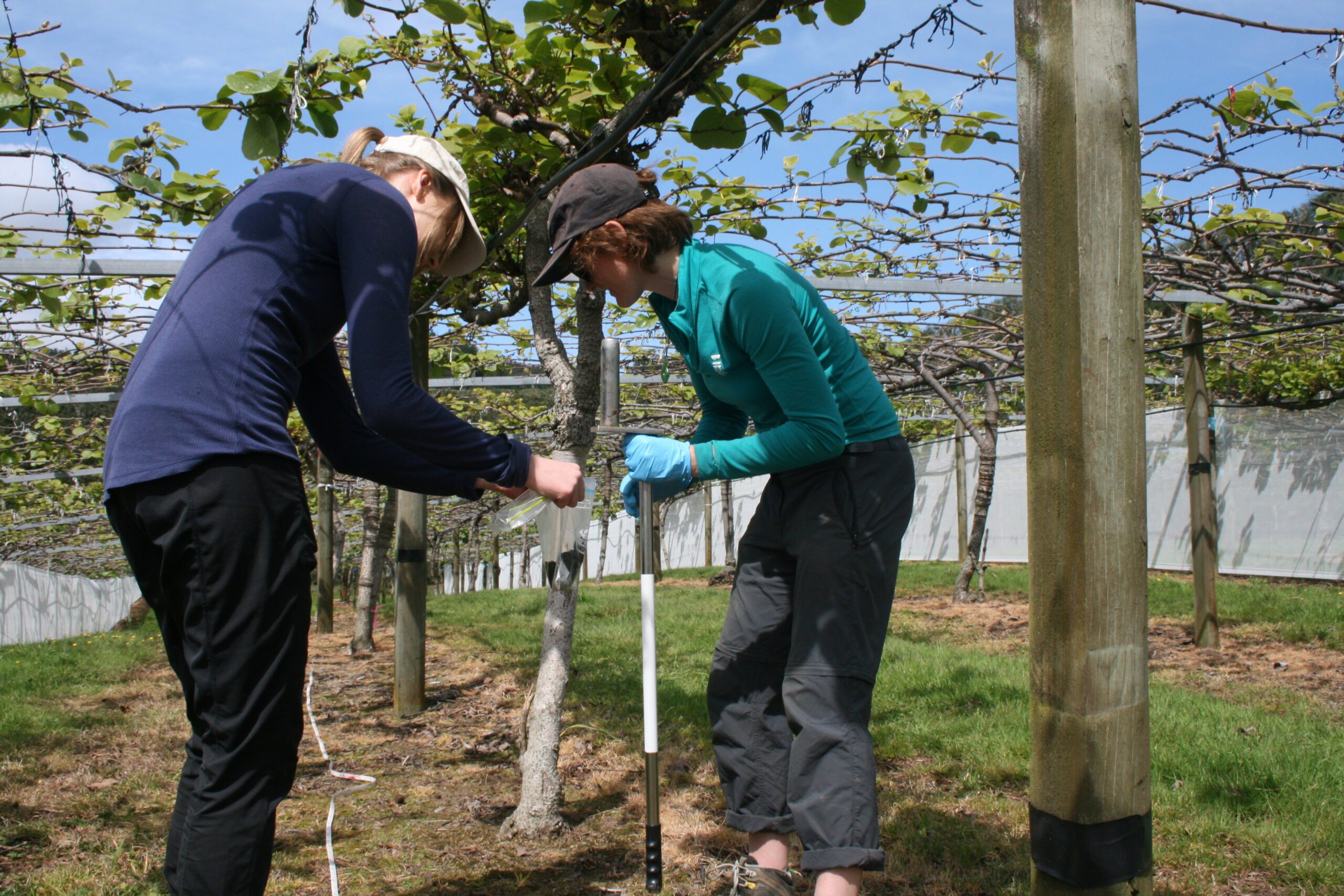
Out in the field: collecting soil samples to uncover the hidden networks of mycorrhizal fungi.
For her PhD, Finn investigated how land-use and climate shapes arbuscular mycorrhizal fungi communities and how these communities impact the resilience of the plants they support.
“Mycorrhizal fungi colonise the roots of plants and extend out into the soil. Colonised plants can better access nutrients and water stored in soil, making them more resilient.”
Finn collected soil and plant root samples from multiple sites across three distinct land-uses (maize fields, kiwifruit orchards and native forest) and compared the abundance and diversity of their fungal communities using fatty acid analysis and DNA sequencing. Sampling was repeated quarterly to detect seasonal shifts in communities.
Once these communities had been characterised, Finn inoculated plants with the particular composition of fungi she had collected at the different sites and exposed these plants to daily temperatures based on future climate change scenarios. Her goal was to determine if certain fungal communities were better at supporting resilience to increased temperature in plants.
While Finn doesn’t describe her results as mind-blowing, she did discover some interesting things.
“Because I sampled seasonally, I was able to look at whether there were seasonal trends in the abundance of these fungi and how those trends differed between land uses.”
Unpacking the Research
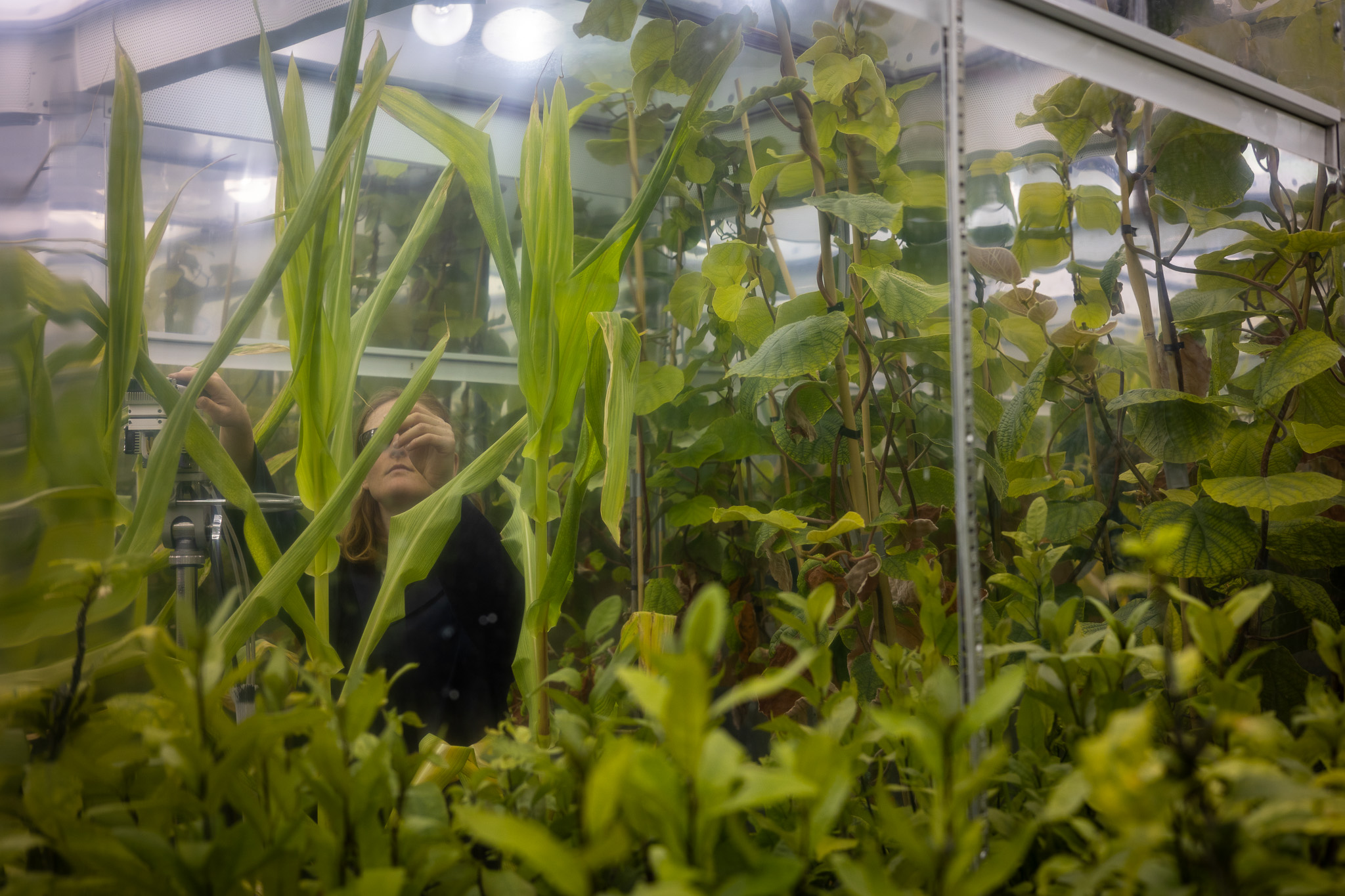
Back in the biotron, working with maize, kiwifruit, and mahoe to understand how plants and fungi collaborate for resilience.
Finn thought that seasonal land management practices, like harvesting and chemical application, would lead to seasonal difference in fungal abundance in the soil of managed land uses (kiwifruit orchards and maize fields). However, the patterns she observed in the managed land uses were actually the same as in the native forest.
“From these results it seems that the practices used to manage land are not driving seasonal changes in fungal abundance. Instead, these shifts could be due to the shifts in temperature and rainfall that accompany changing seasons,” says Finn.
Although the seasonal trends were similar, the sheer volume of fungi did differ between land use types.
“Land management is having an effect on the amount of fungi we find in a system, with a much higher abundance in the unmanaged and less disturbed native forest.”
Finn hopes to write up these results, and those from her experiment on temperature, into papers over the next few months, assuming she can find time in her busy schedule.
“I’m working as the manager of a ski field in Arthur’s Pass this winter,” says Finn. “It’s nice to use the other side of my brain for this very physical and very social work that is so different to my PhD. At the same time, I know the skillset I developed during my PhD will come in handy, such as in managing the many diverse aspects of the job and handling setbacks with resilience.”
More Information
- Research | Mycorrhizal Fungi in Resilient Plant-Soil Ecosystems
This project explores how mycorrhizal fungi shape plant-soil interactions and contribute to the resilience of ecosystems under stress.
Read the full project overview >>