
 Home
Home24 October 2024
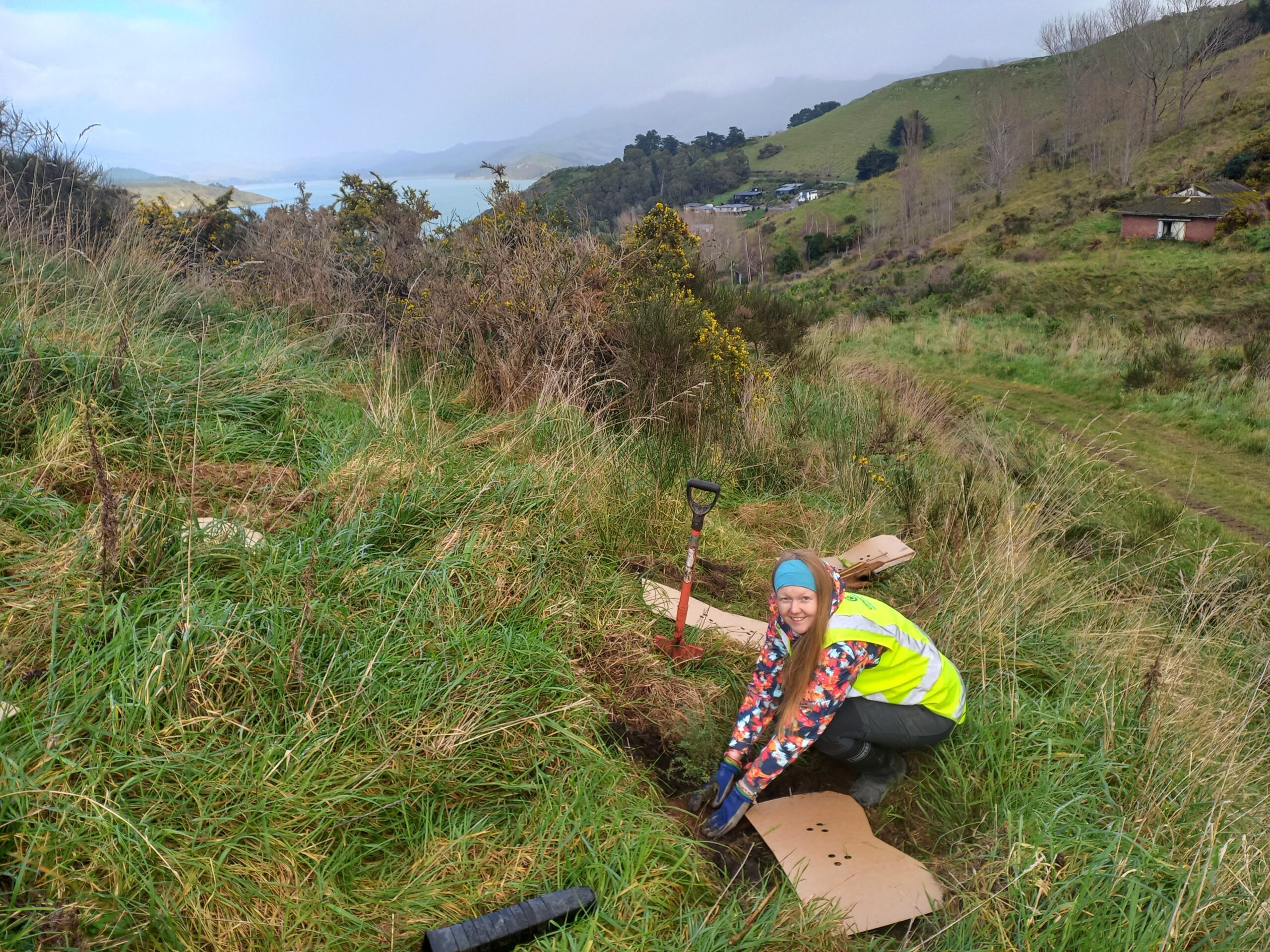
Friederike Espinoza at a native tree planting at Steadfast Reserve, Cass Bay, Lyttleton (photo by Hugo Espinoza).
Looking for more ways to learn about native plants, Friederike Espinoza (a Bioprotection Aotearoa PhD student from Germany) has been participating in conservation volunteering here in Aotearoa. Through this, Friederike has indeed learned about plants. But she has also found community and developed an enduring desire to support conservation objectives in a hands-on way. Here, Friederike shares her reflections on the value of this experience.
I have always been fascinated by plants. Seeing how plants grow from a tiny seed to a flowering plant and are able to adapt to environmental changes and different climates amazes me. To follow my interests, I studied Agricultural Sciences with a focus on crop protection in Germany, my home-country. After my Bachelors and Masters degrees, I gained professional work experience in horticultural research projects, detecting spider mite damage on plants using hyperspectral imaging and also advising vegetable and berry farmers in plant protection and integrated pest management.
Agriculture isn’t the only subject I am interested in. Ecology and protecting the environment play such an important role in agricultural systems and sustainable farming. My passions for more general plant science and specifically sustainable land management led me to apply for my current PhD at Lincoln University. My PhD focuses on weed invasions in New Zealand shrublands, which introduced me to the fascinating world of ecology and invasion biology.
In my PhD, I have conducted a vegetation survey as well as field and greenhouse experiments to investigate factors driving alien weed invasions in kānuka shrublands. This includes looking at the role of plant traits, land use change and habitat fragmentation.
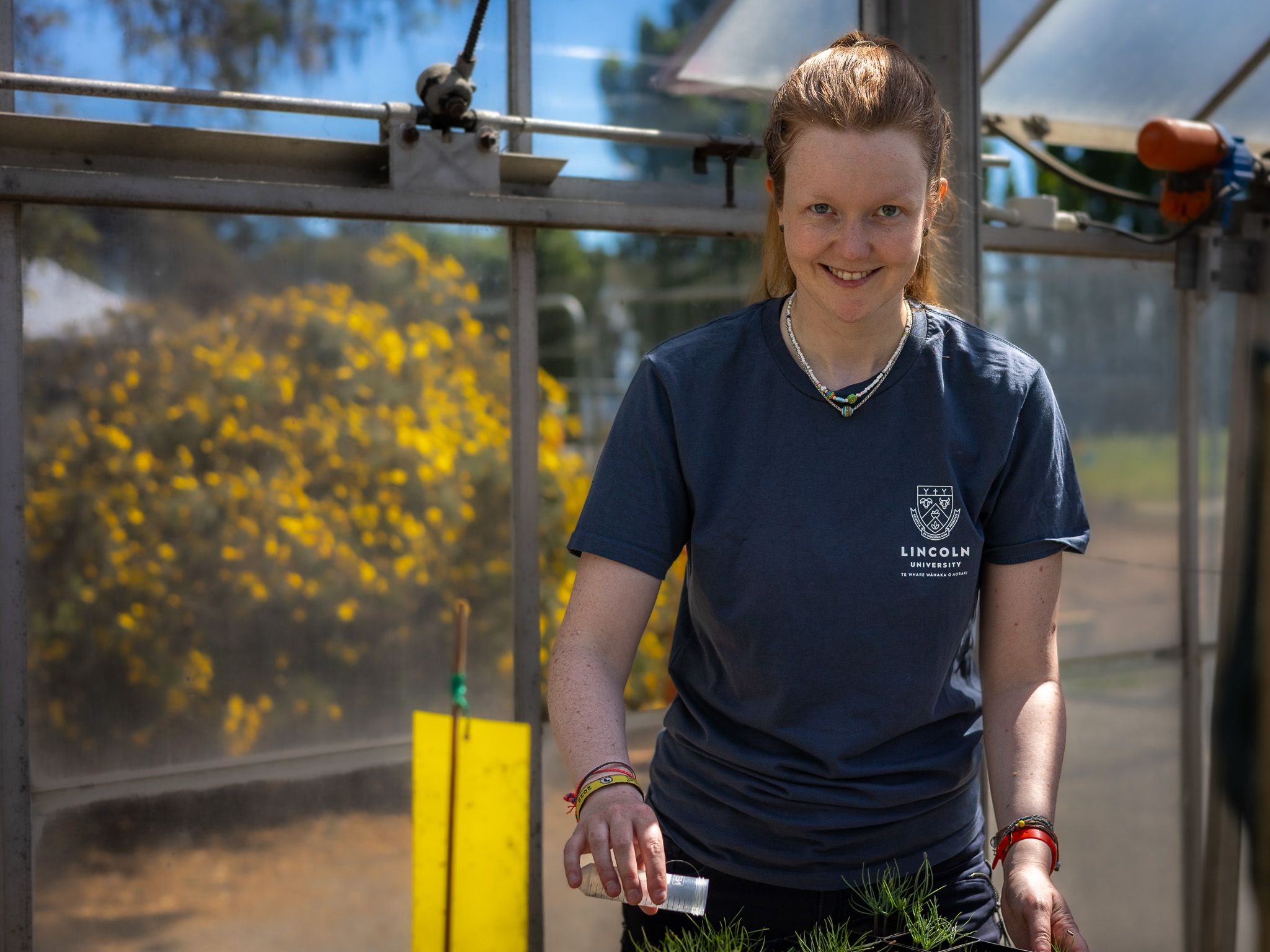
Friederike in the glasshouse at Lincoln University (photo by Zohar Marshall).
New Zealand is a great place to study weed invasion in native shrublands and it is so interesting to learn more about the challenges of plant invasion. Native shrublands such as kānuka are highly valuable for local and Indigenous communities in Aotearoa and for the wildlife such as birds and insects. However, the vulnerability of native ecosystems to weed invasion and alien weed invasion is an understudied component of native ecosystems.
Discovering conservation volunteering
As I grew to love New Zealand’s native vegetation and plants through my PhD, I wanted to learn more about them and do more to protect them. So, I started volunteering in conservation work in my free time. I have helped at several restoration events by planting native trees such as kānuka, mataī, kahikatea, tī kōuka, and harakeke for different organisations in the Ōtautahi and Horomaka area. It was satisfying to see how the plants would develop and grow. I’ve also learned that conservation work involves much more than planting native trees—it’s important to come back for weeding too, because (as I’ve learned through my PhD) weedy non-native plants are often so successful at establishing due to their biological traits. Native plants are then forced to compete with non-native weeds for resources like nutrients, water, and light. So weeding and other maintenance tasks remain important aspects of this work.
I enjoy going to planting events and doing volunteer work for three reasons. First, it helps increase biodiversity, regenerate the landscape and provide food and shelter to birds and insects. Second, it helps give future generations a way forward in continuing to protect the unique natural environment in Aotearoa New Zealand. And most important, I have met many people at these events, all of whom are interested in and engaged with conservation and nature. They inspire me and motivate me to come back.
I keep learning more and more about protecting and managing ecosystems and the importance of functional ecosystems for people and communities. Back in Germany, I didn’t engage in conservation volunteering and have never been actively involved with planting and weeding in natural areas and native ecosystems. But it is such an amazing and fun thing to do, that now, I’m hooked.
I even received the Community Engagement Award at the Waitaha Canterbury International Student Awards 2024 for the volunteer work I have contributed to conservation. This award is for international students who have been actively engaged with the local community, and it was touching to be recognised for this effort and seen as an important part of the community.
I’m glad I followed my interests and tried something new. Conservation volunteering has helped me learn more about Aotearoa’s native plant life, get hands-on experience on restoration projects and engage with the community. It’s a lot of fun – You should try it sometime!

Waitaha International Student Awards held at Nga Hau E Wha National Marae (photo by Hugo Espinoza).
More Information
Learn more about Friederike’s research here > Weed invasions in New Zealand shrublands