
 Home
Home8 April 2026
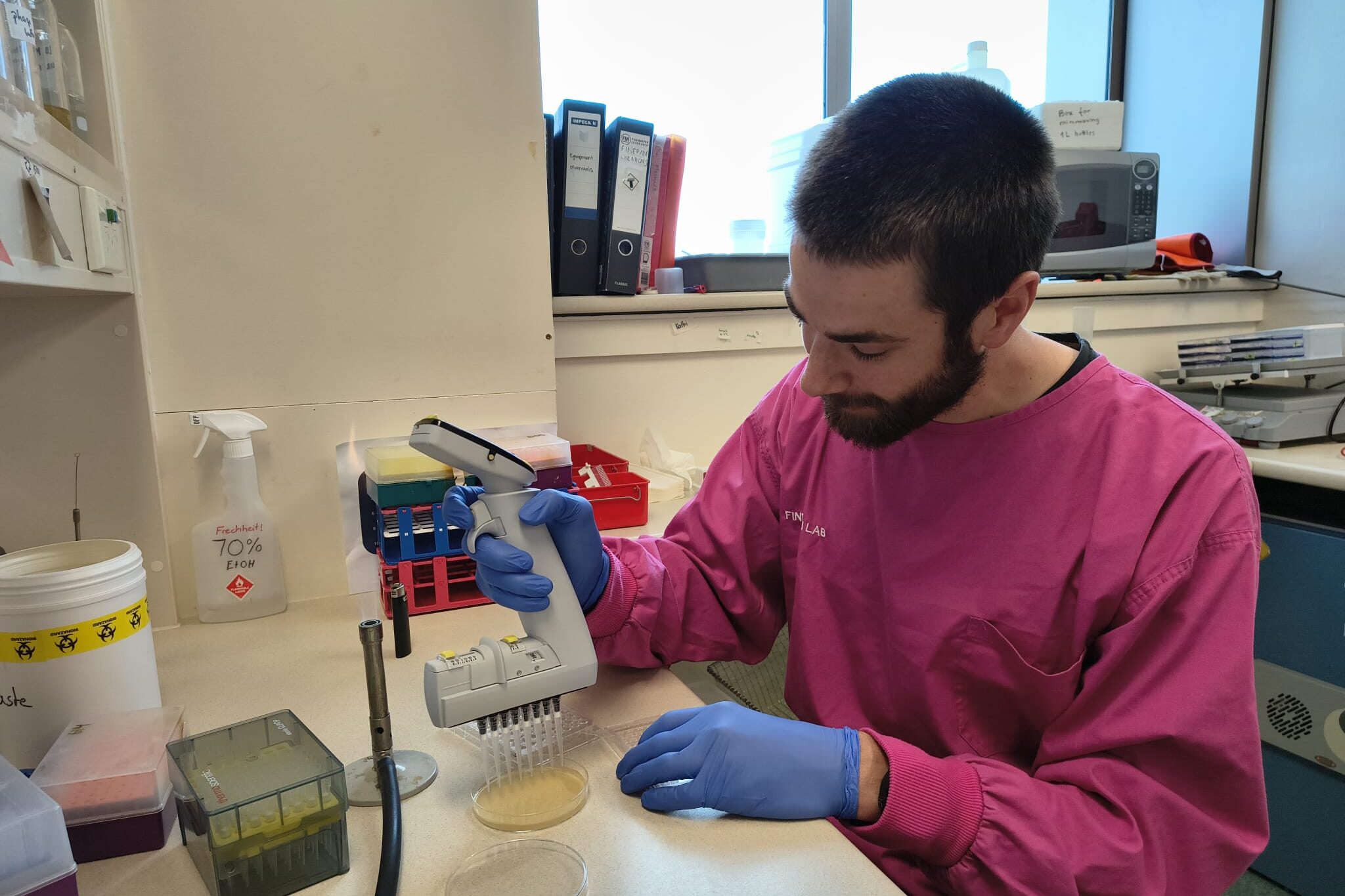
PhD student Rene Zschoche in the lab.
Bacteriophages, viruses that infect bacteria, are promising alternatives to antibiotics in a variety of fields including bioprotection. When these “phages” are used to control a pathogen, three or four might be mixed together in a cocktail in hopes of an additive, “the-more-the-deadlier” effect.
However, little is known about how different phages interact with each other. Do they compete or collaborate? Are they in fact antagonistic? When two phages infect a cell at the same time, what actually happens?
These are the questions that Rene Zschoche is working on for his PhD. A Bioprotection Aotearoa student supervised by Peter Fineran at the University of Otago, Rene is generously sharing with Aotearoa his phage expertise, which he cultivated during his Master’s in Germany.
“I really liked working with phages during my Master’s and thought I might continue for my PhD,” says Rene.
Rene didn’t start out in this field. Instead, his original interest was in genetics. He did a Bachelor’s thesis in genetics, focusing on smut fungi infecting maize plants, thinking he would love it.
“It was not my cup of tea,” admits Rene. “Not because of the genetics, but because everything took forever. Plants grow slowly and the fungus grows slowly as well.”
After finishing his Bachelor’s thesis, Rene found work in a newly established lab with a professor he knew he enjoyed working with. This led to his Master’s which in turn has led him here, where he is less than a year into his PhD.
“I’m not at a stage where I can say I have results, but I think I’m making good progress.”
Currently, Rene is working with about six promising phages commonly used in the Fineran lab to see how they interact with each other in a bacterial culture.
“This may be beneficial interactions, but we mainly think that there will be competition.”
Rene’s predictions are based on previous research into phage interactions.
“Competition has been shown in phages that are closely related to each other, but there’s very little data out there about phages that are not closely related to each other.”
This is important because phage cocktails generally use distantly related phages.
“Antibiotic resistant bacteria are emerging, and phages can be useful in treating those antibiotic resistant bacteria,” says Rene. “But if we just use one phage to treat a pathogen, then it will likely mutate and become resistant to the phage, creating the same problem. So what we do is we use multiple different phages against that one pathogen.”
Knowing how phages interact will help inform the design of more efficient, effective cocktails. The application of this knowledge will be useful across many fields, such as medicine, biocontrol or food science.
“It’s quite a big field where they can be applied later on.”
What are naturally occurring phages? By Te Tira Whakamātaki in collaboration with Rhiannon James Graphic Recording.
It’s still early days for Rene and his research. While he hasn’t yet generated knew knowledge about phages, he is reinforcing his own knowledge about the lab environment.
“It’s always the same with science, especially lab work,” he says. “When something doesn’t work, try harder. And honestly it might be a stupid reason why it doesn’t work. But try again and at some point it will work.”
When Rene isn’t working hard in the lab, he can be found enjoying the natural wonders of Aotearoa.
“New Zealand is great,” says Rene. “On the weekends, you can go like two hours with your car and there’s a spot you’ve never seen before and everything looks different from what you’ve seen so far.”
Additional Information
- Research
To learn more about Rene’s research on phage-phage interactions, visit the project.
Learn more about the research >>
- Biocontrol Against Microbial Threats
To explore other projects investigating phage interactions to develop biocontrol tools against plant pathogens in a changing climate, visit the project stream.