
 Home
Home8 July 2025
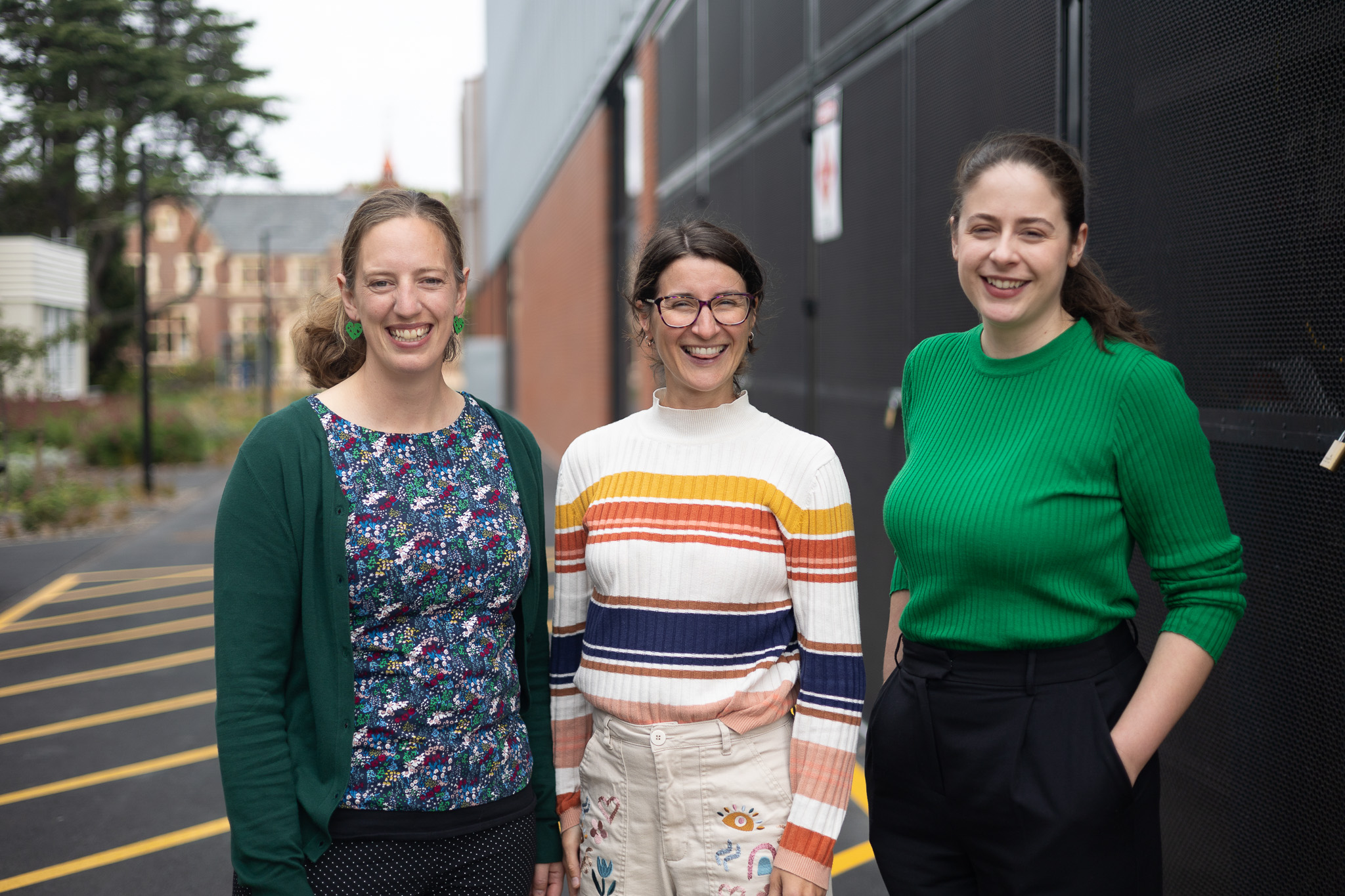
Dr Sarah Inwood (far right) and colleagues. Photo: Zohar Marshall
Dr Sarah Inwood is building a biocontrol research empire using well-earned funding from a Marsden Fast Start Grant, awarded in November last year. But as with any big accomplishment, she got there via a series of smaller steps. Bioprotection Aotearoa has been privileged to be an accomplice at several stages of her journey.
Improving agricultural outcomes is part of Sarah’s DNA. Growing up on her family’s farm outside of Christchurch, Sarah credits this environment for sparking an early interest in science and its applications.
“I’ve always been interested in science, particularly the tangible stuff that can be applied to better the environment or agriculture,” says Sarah. “That’s part of how I became involved in Bioprotection Aotearoa. It has everything that I’m interested in all being done in the same place, with really cool people and support.”
Sarah completed her undergrad at the University of Otago and even completed a summer studentship with Bioprotection Aotearoa’s predecessor (Bioprotection Research Centre) working with fungi. Not knowing exactly what she wanted to do after her third year, she talked to some of her professors at Otago.
“I have been working in the same supportive, welcoming lab ever since, working with Peter Dearden, who’s just great,” says Sarah. “And we study all sorts of weird, fascinating stuff.”
One of these weird, fascinating things is the biocontrol system for the Argentine stem weevil. The weevil is ostensibly controlled by a parasitoid wasp, introduced to Aotearoa in the 1990s. However, the effectiveness of this biocontrol agent has declined over time.
For her BioProtection Research Centre-funded PhD, Sarah homed in on the weevil.
“Because we thought that the weevil had evolved resistance to the wasp, the focus of my PhD was on understanding how that resistance might have evolved,” says Sarah.
A clear answer did not emerge from this line of research. However, along the way, Sarah started doing a little bit of work on the wasp as well.
“Doing a lot of reading, I found that lots of parasitoid wasps have quite intricate relationships with viruses,” says Sarah.
It was the first time Sarah went to her supervisor with a research direction of her own, something outside of what she had initially planned for her PhD.
Sarah used one chapter of her PhD to investigate whether viruses were present in this wasp and other parasitoid wasps used for biocontrol in Aotearoa. Sure enough, she did find a virus that infects the Argentine stem weevil parasitoids.
This discovery, followed by some preliminary research as a Bioprotection Aotearoa postdoctoral fellow, supported her successful application for a Marsden Fast Start Grant.
“It’s been really cool to follow up with something on a track that I started down myself,” says Sarah.
This grant funds Sarah to investigate the impacts that the virus she discovered might have had on biocontrol efficacy, looking into whether it might be linked to declining rates of parasitism, for example. To accomplish this, Sarah and the team at the Dearden lab will track the virus’s spread by comparing historic and modern wasp samples and also test the virus’s effects on wasp behaviour.
One of the challenges in determining the behavioural impact of the virus is that Sarah can’t find wasps that aren’t infected in Aotearoa today.
“This wasp was first brought to Aotearoa from about eight different locations in South America,” Sarah explains. “It looks like initially only some of those wasp populations had the virus. But over the course of rearing in containment, through mechanisms we don’t yet know, all wasps ended up infected.”
This makes it difficult to understand what this virus really does.
“We need an uninfected group to compare it to,” says Sarah. “It’s still something we’re exploring how to work around.” As a part of her Marsden Fast Start grant, Sarah will attempt to treat wasps to clear the viral infection if no uninfected wasps can be found in Aotearoa today.
As she pursues this Marsden-funded work, she will also continue with her BA-funded postdoctoral work by co-leading a project looking into how the wasp uses olfaction to actually find weevils and figure out if a weevil has already been parasitized, alongside studying the co-evolution of the wasp and virus.
“If we can understand this biocontrol agent better, we can hopefully develop tools to increase their efficacy,” says Sarah.
More Information
You can find out more about the research Sarah is co-leading within Bioprotection Aotearoa here >> Future Biocontrol