
 Home
Home8 July 2025
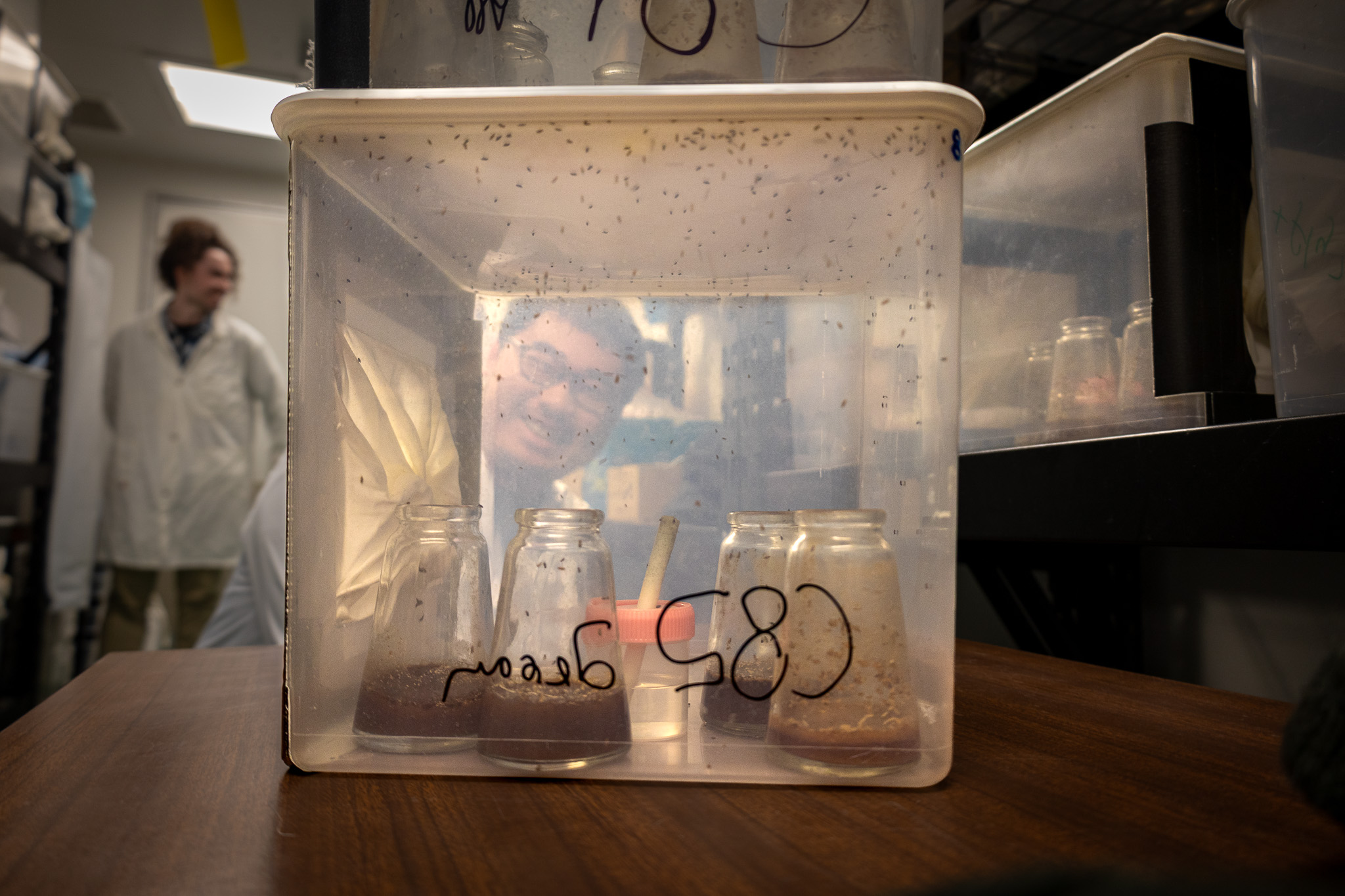
Li in the lab with a box of fruit flies. Photo: Zohar Marshall
Li Wang is two years into his PhD exploring the eco-evolutionary dynamics of exotic fruit flies and the parasitoid wasps that we hope will continue to control them. In a recent catch-up, Li shared the origin of his love for science and some recent developments in his research.
Li can trace the origin of his interest in science to watching documentary series on the Discovery Channel and BBC as a child in Beijing.
“At the beginning, I was more into the ‘fun’ programs, like Myth Busters,” says Li. “But there would also be shows about beautiful Madagascar, nature and ecology, and ancient beasts. These programs led me into understanding the importance of the ecosystems around us and how things might change over time.”
Li followed his interest in science to the University of California Davis, where he majored in Ecology, Evolution, and Biodiversity. After his undergraduate he completed his Master’s at Imperial College London.
“I worked on two projects for my Master’s, one of which was on the evolution of morphology of bumblebees of the British Isles,” says Li.
Li and his colleagues measured 150 years’ worth of museum specimens to see if bumblebee morphology changed over time.
“And they did change a lot,” he says. “They have become larger and now have more diverse wing shapes. It was fascinating to see the differences.”
At Imperial, he met a visiting professor, our very own Jason Tylianakis, professor in the School of Biological Sciences at the University of Canterbury.
“Before he left, he shared an advertisement for a funded PhD program,” says Li. “They were looking for somebody who knew a little bit about insects and was interested in studying ecoevo dynamics.”
Feeling like that was something he would enjoy, Li applied for and was accepted for the role.
Studying an evolutionary arms race
As a Bioprotection Aotearoa-funded PhD student at the University of Canterbury, Li has gone from studying bees to studying fruit flies (which can be a biosecurity menace) and parasitoid wasps. Parasitoid wasps inject their eggs into the larva or pupa of fruit flies; the eggs hatch and the parasitoid larvae eat the host from inside out, eventually killing and emerging from the host as a mature wasp.
The ability of parasitoids to kill their hosts makes them useful biocontrol agents in New Zealand. However, their hosts are not defenceless.
“If a fruit fly larva notices the attack early enough, it can generate a capsule around the parasitoid egg, stopping it from developing.”
Another point of interest is that studies have shown that hosts usually adapt better to altered climates than parasitoids, potentially leading to future pest outbreaks.
Li’s project examines the fruit fly – parasitoid study system in simulated climate change and dispersal scenarios. It focuses on understanding how the structure and strength of this relationship evolves to influence functional traits, parasitism and resistance rates, and fertility of both hosts and parasitoids.
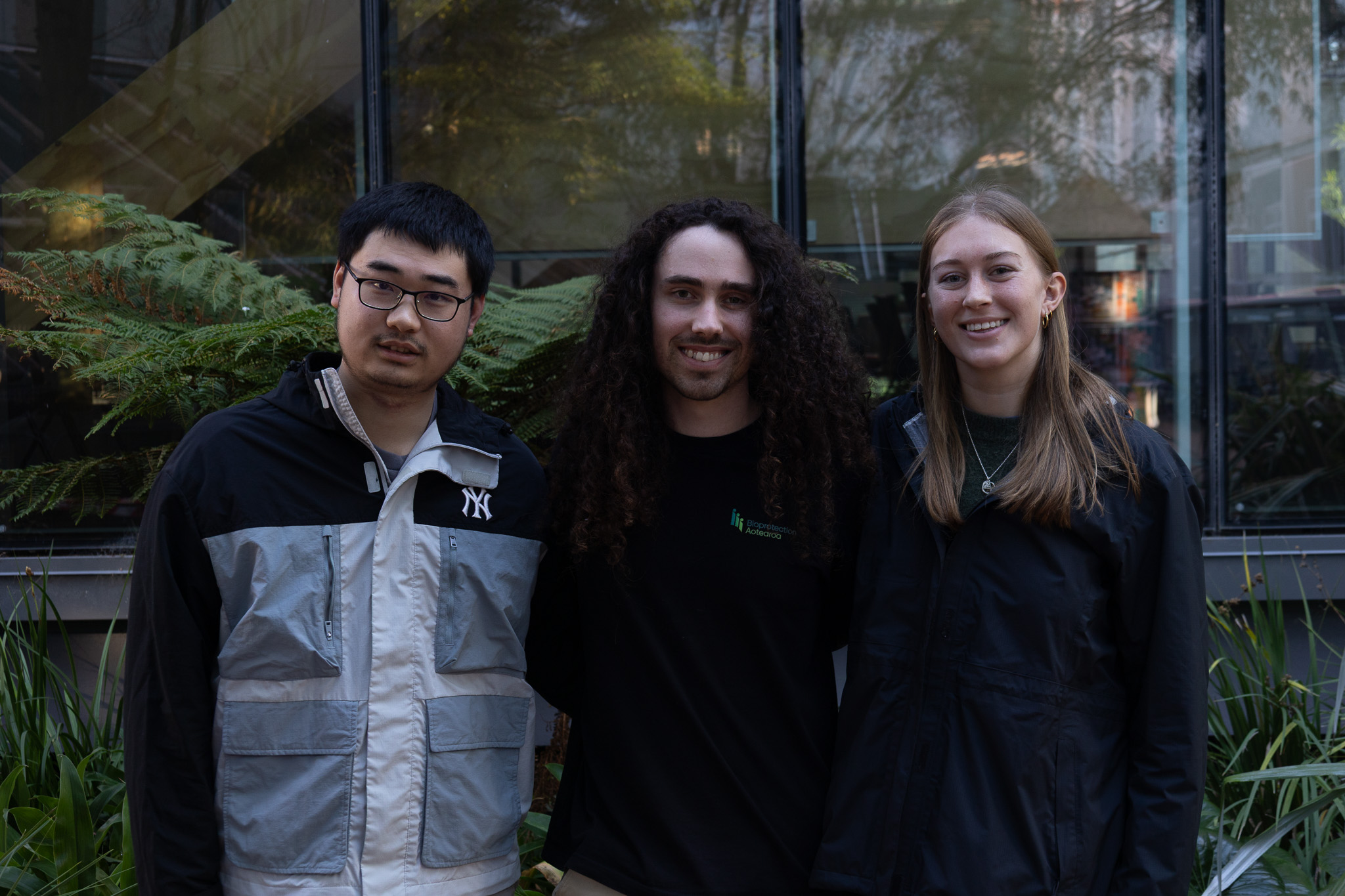
Professor Jason Tylianakis’s lab group
With two years under his PhD belt and one year left to go, Li says he’s learned a lot by carefully observing his study species.
“My study species are way more evolutionarily flexible than what we previously thought, especially the parasitoids,” says Li.
Initially, Li had believed that the parasitoids would be highly reliant on the fruit flies and extremely vulnerable fluctuations like temperature change, as is suggested in the literature.
“Actually, they may keep up with and sometimes overcome the evolution of defences by the fruit flies, particularly when flies are dealing with high stress conditions,” says Li.
Li hopes that what he learns during his PhD will inform how to prevent pests from evolving to defeat their natural enemies under climate change.
As much as Li has learned about his study system during his PhD, he has also learned about himself.
“I truly enjoy nature,” says Li. “In New Zealand, there are a lot more opportunities to get in contact with the nature than in the more developed cities where I’ve previously lived. When I go hiking on the weekends, there are always fascinating little native plants or animals that we pass that are new and fascinating to me as somebody who watches the same four introduced species every day for work.”
More Information
You can find out more about Li’s research here >> Eco-Evo Dynamics of a pest-parasitoid community