
 Home
Home3 May 2026
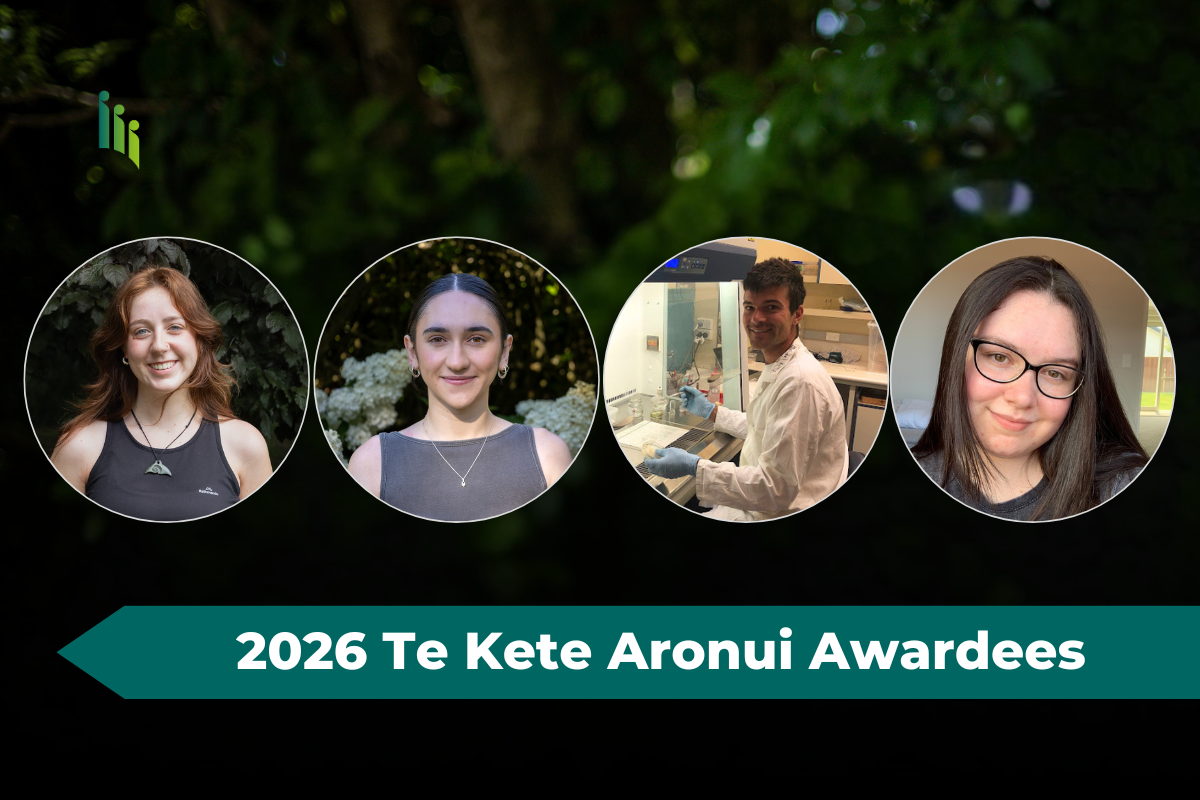
Autumn Lindsay, Jaymee Anahera Shadbolt, Michael Riley and Lyn Young.
For the first time, we’ve been able to give four of our summer scholars an extra career boost with the Kete Aronui Award. These scholars—Autumn Lindsay, Jaymee Shadbolt, Michael Riley, and Lyn Young—were each awarded $2,500.
Deputy Director, Dr Sylvia Nissen (Lincoln University), noted that all the applications she received for the award were very strong, but these applications were a step up from the rest.
“This achievement reflects not only their hard work but also their ambitions to be contributors to the future of bioprotection research and innovation,” says Sylvia.
As a way of meeting our awardees, here are some edited selections from their larger applications. We hope they provide a taste of the continued impact of their work and the contributions they will make in this field.
Autumn Lindsay
I was looking at the ectomycorrhizal morphotype diversity with Pinus radiata (supervised by Nicola Day).
Looking back, this scholarship has given me far more than technical experience. It gave me a new academic direction, a deeper understanding of ecological research, and a much clearer understanding of myself and the work I find meaningful and worth pursuing. I had not anticipated being so drawn in, but exposure to the complexity of soil ecology and the ability to experience it hands-on made it impossible to ignore the growing interest. Even while focusing on a relatively small component of a much larger system, I was struck by how ecologically significant that small-scale work really was. That shift pushed me to reconsider what I considered important in ecology and what drove my interests.
One of the clearest indicators of how much my engagement had changed was the extent to which my curiosity became self-sustaining. I stopped seeing the project simply as something I had been assigned to do and became genuinely invested in the questions it was raising—thinking not just about how to complete the work, but what the samples might reveal, what patterns might emerge, and why those patterns mattered. For me, seeing a project through to completion is not simply about responsibility or work ethic, although those matter, but also a genuine desire to pursue understanding as completely as is within my means.
Moving forward, I want to continue building towards a career in scientific research and conservation, particularly work that contributes meaningfully to understanding and protecting ecological systems in Aotearoa New Zealand.
Jaymee Shadbolt
As a BA Summer Scholar, I examined Māori perspectives on biosecurity, supervised by Raven Cretney and Aline Carrara at Lincoln University.
As I settled into being a BA Summer Scholar, I began learning how to do research. Not just reading articles, but finding information, organising, coding, and making sense of it. I learnt how to pull ideas together and carry them through my writing in a way that told a story. Finalising my report, presenting, and experiencing the process from beginning to end gave me a sense of what research involves.
More personally, the most significant part of my journey was exploring my connection to being Māori. I developed a deeper understanding of Te Ao Māori and the interconnectedness of everything. I began to see clearly why biosecurity matters, not just in an environmental sense, but in a cultural, social, and intergenerational one. Once I understood, it became impossible to see biosecurity as anything less than critical. This connection to something beyond myself gives this pathway meaning for me. I want to pursue a career that contributes positively to the world, and this experience has shown me that this space allows me to do that.
Looking forward, I have developed a genuine curiosity for research, finishing this experience with more questions than I started with. Research wasn’t something I had seriously considered before, but I now see it as a real and exciting pathway. Similarly, I see biosecurity as a viable and meaningful pathway that sits at the nexus of my different areas of study.
Michael Riley
For my BA summer scholarship I worked at the Bioeconomy Science Institute in Rotorua, supervised by Dr Rebecca McDougal. I investigated biological control agents for forest nursery pathogens, with the aim of identifying biological control candidates for sustainable disease management.
My background isn’t typical for a plant pathologist, but I believe that is exactly why I have something new to bring to the table. After a decade in the construction industry, I began growing mushrooms as a hobby, but my interest grew rapidly. Before long, I had put my tools down and committed to formal study. I am now a third-year Bachelor of Environmental Science student at the University of Waikato, majoring in Ecology and Biodiversity. Alongside this, I founded Mushroom Bay, a small-scale gourmet mushroom business.
Through this process, I saw strong parallels between laboratory work and the natural systems I engage with outside of science. Observations made under the microscope mirrored those I see in ecosystems, where organisms are constantly competing, adapting, and coexisting. This reinforced my interest in understanding microscopic interactions not only in controlled environments, but within the complexity of real-world systems.
Looking ahead, I aim to deepen my understanding of plant–pathogen interactions by combining scientific methods with field-based observation. I am particularly interested in pursuing post graduate study in a remote region of Asia, where many of the exotic pathogen and pest species present in Aotearoa originate, and where long-established productive forest systems and management practices offer insights into resilient ecosystems.
Lyn Young
I undertook a BA Summer Scholarship at the Bioeconomy Science Institute in Lincoln, supervised by Dr Virginia Marroni. My project focused on the phylogenetics and epidemiology of the bacterium responsible for bacterial spot disease in Prunus species.
I came into the scholarship having just completed my undergraduate degree, with laboratory experience almost entirely by structured fortnightly lab sessions with predetermined, fail-safe results. The BA summer scholarship felt like a turning point for me. I was able to build substantially on the core skills I had gained during my undergraduate, while learning how real-world research actually works.
Part of what made the experience most meaningful was seeing the work in connection with the people it affects. Visiting local walnut growers and hearing about treatment trials directly gave the research meaning for me. These growers were losing 80-90% of their harvest yield for the year, with little compensation for participating – and yet they chose to. While detrimental in the short-term for them, trials are ultimately an investment in the future of their orchards. Hearing their reasons for collaborating with our work left me with a lot to think about.
My next step is completing my Honours thesis this year – which was directly shaped by the scholarship. I see Honours as my path to entering industry research, building computational and analytical depth to compliment the practical confidence I gained throughout the scholarship – all preparing me for the kind of applied CRI environment I hope to work in long-term.
Additional Information
- Summer Scholarships
We regularly share bioprotection insights and upcoming opportunities with our newsletter subscribers. To be the first to hear when the next round of Summer Scholarships opens, sign up for our newsletter.
- Outreach
To learn more about our outreach and engagement programmes with tertiary students, schools, iwi, hapū and community groups, explore our projects.