 Home
Home


Project Details
Project status
Completed
Research Framework
Pou Nuku-a-rangi
Research Duration
Jan 2022 – Dec 2024
Project Overview
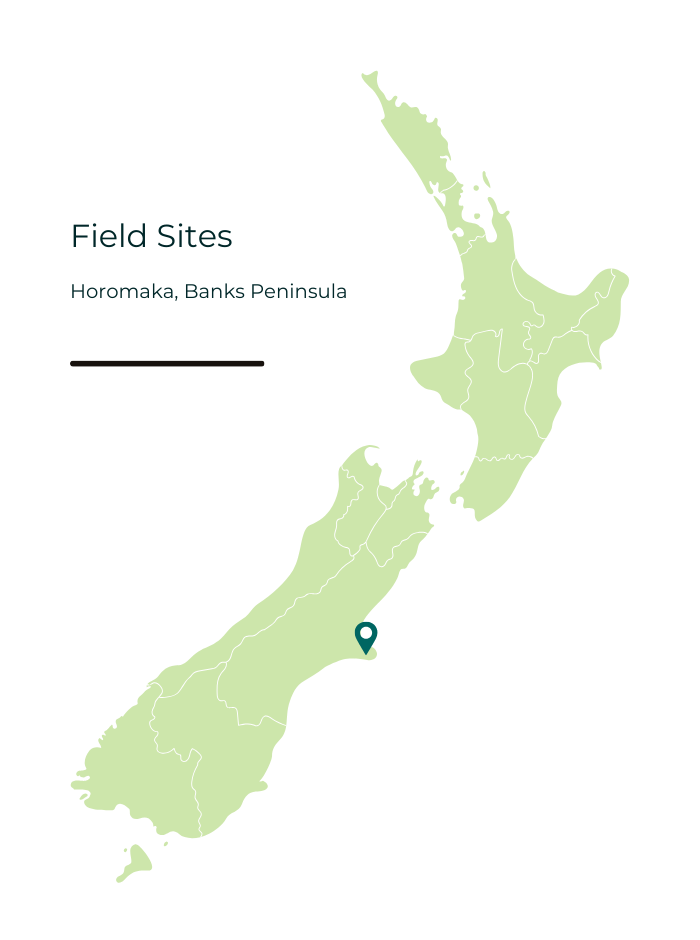
This project is examining the impacts of agricultural land-use change on soil carbon cycling across an agricultural landscape in Horomaka, Banks Peninsula. Carbon stored in soil supports a range of soil ecosystem services that are essential to human needs, such as agricultural productivity and the regulation of water quality and greenhouse gases. As soil microorganisms drive both the decomposition of and formation of soil carbon, studying their response to land-use change is essential to provide ecologically meaningful assessments of soil carbon.
Our research is examining differences in the diversity, structure, and function of the soil microbial communities between different land uses across Horomaka, Banks Peninsula.
Five different land uses were selected for comparison across an agricultural land use mosaic, which included native forest, pasture, and exotic forest. The results of this research will enable us to better understand how we can manage land uses to enhance the resilience of soil carbon.
Why This Matters
Enhancing soil carbon storage is an essential tool for us to mitigate the rise in atmospheric carbon emission, CO2 , and the effects of climate change.
Understanding how to sustainably manage agricultural landscapes is important for us to enhance long-term agricultural productivity and soil health
This research will support our understanding of how human land use change and management impacts the resilience of soil carbon.
Project Objectives
- Understand the impacts of land use change on the quantity and quality of soil carbon across an agricultural land use mosaic
- Understand the impacts of land use change on the diversity and function of soil microbial communities across an agricultural land use mosaic
Research Outputs
Journal Articles
- Land Use Change Disrupts the Network Complexity and Stability of Soil Microbial Carbon Cycling Genes Across an Agricultural Mosaic Landscape (2025)
- Land use intensity is a major driver of soil microbial and carbon cycling across an agricultural landscape (2024)
- Lifting the Profile of Deep Forest Soil Carbon (2024 – aligned)
- The hidden depths of forest soil organic carbon chemistry in a pumice soil (2024 – aligned)
Webinar
Conferences
- Land use intensity is a major driver of soil microbial carbon cycling across agroecosystems in Aotearoa New Zealand (2025)
Poster – Rhizosphere 6 – Rooting for Earth - Land use intensity is a major driver of soil microbial and carbon cycling across an agricultural landscape (2024)
Talk – New Zealand Ecological Society Conference
Project Team

Dr Alexa Byers
Roles:
Postdoctoral Fellow Tranche 1
Institution:
Lincoln University