
 Home
HomeProject Details
Project Overview
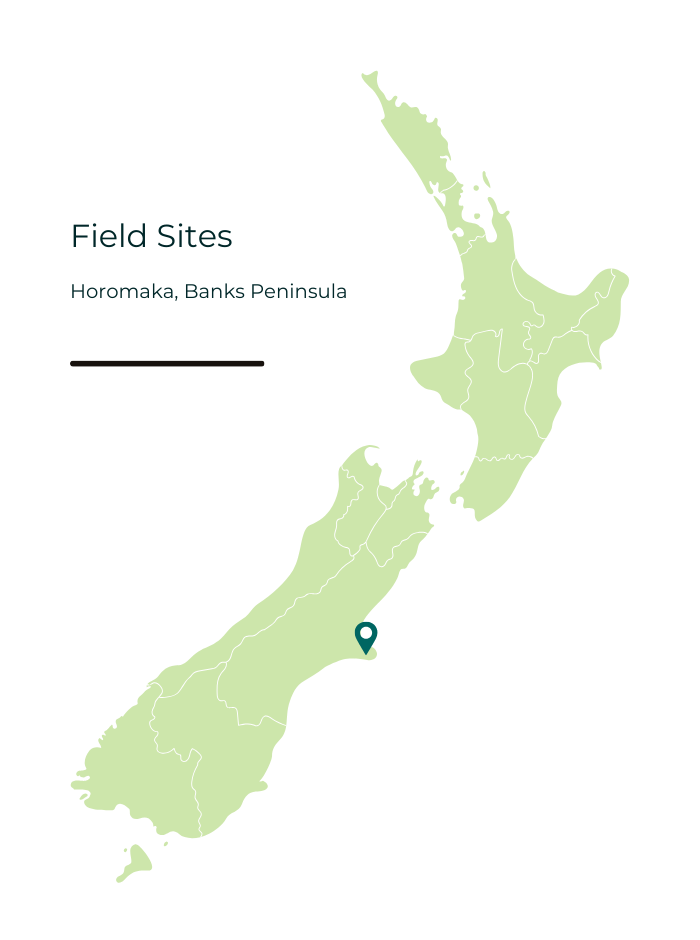
In this project, we are investigating how different agroecosystem management practices alter soil carbon storage and how soil microbes respond to these changes. Our first experimental site is a long-term afforestation trial at Orton Bradley Park, where pasture was planted in pine and eucalyptus 26 years ago. By comparing these forested trial plots to the nearby pasture control, we aim to understand how much carbon is stored down the soil profile to 60 cm, how stable that carbon is, and whether tree species influence carbon retention.
Our second experiment focuses on a long-term grassland trial at Lincoln University that has been managed for decades under different mowing and biomass regimes. Here we will explore whether maintaining or removing plant material after mowing affects soil carbon, nutrient dynamics, and microbial and viral communities.
Finally, we are running a third experiment that involves transplanting microbiomes from the grassland trial treatments into an agriculturally depleted soil within a glasshouse setting. This will allow us to determine if we can increase carbon retention through bioremediation in a controlled environment
Why This Matters
 Understanding how land-use management practices impact the stability of soil carbon can help us support productive and climate-resilient agriculture. This work will assess how planting pasture land to trees and long-term grassland management influences carbon storage and the soil microbiology that drives it. If we do not address these questions, we risk losing soil carbon, reducing soil fertility, and increasing greenhouse gas emissions.
This project is aimed to support farmers, landowners, and the government by identifying practices that build soil carbon and protect soil health. It also contributes to the wider community by providing details about climate-smart land management.
Project Objectives
- Determine how different tree species and pasture management affect the amount and chemical stability of soil organic carbon down to 60 cm depth.
- Quantify how long-term grassland biomass management (biomass retained, biomass removed, and non-mown) influences soil carbon, nutrients, and microbial activity.
- Characterise bacterial and viral communities under contrasting managements and depths, and link these to carbon cycling and microbial functioning.
- Test whether microbiome “transplants” from the long-term grassland trial can improve carbon retention and microbial function in an agriculturally depleted soil.
Project Collaborators
Project Team



Dr Alexa Byers
Roles:
Postdoctoral Fellow Tranche 1
Institution:
Lincoln University