
 Home
Home22 November 2025

Pearl Ruston (left)
Three Bioprotection Aotearoa Masters students graduated recently and have joined the work force. Here’s what Pearl Ruston has to say about what she accomplished during her Masters and what she’s up to next.
Place of study and thesis title
Victoria University of Wellington – Thesis title: The effects of ecological restoration on nitrogen partitioning in wetland ecosystems.
About the project
My master’s research looked at three wetland states; unrestored (actively farmed), restored (previously farmed wetlands undergoing restoration), and remnant (intact swamp forest) to explore how ecological restoration influences nitrogen pools and fluxes. To understand where nitrogen pools, I measured the nitrogen content in soil (total, mineral, and microbial forms) and in plant tissues (wood, bark, leaves, and roots). To understand the flux of nitrogen, I used nitrogen isotopes (δ^15 N). Using this data, I found that wetland restoration enhances nitrogen storage, but restored wetlands have not yet reached the nitrogen retention capacity of remnant wetlands. We also found that establishing long-lived shrubs and canopy trees during wetland restoration appears crucial for rebuilding the nitrogen storage and retention capacity of wetlands.
Outside of your “main findings”, what did you learn through the Master’s process?
During my MSc, I was lucky to work with a geospatial tool called LUCI (Land Utilisation Capability Indicator), which opened my eyes to the power of mapping and spatial data. I learnt how this sort of data can be used to understand land use changes, make land management decisions, and ultimately see where wetlands and their nitrogen retention capabilities sit in the bigger picture of landscape resilience.
Current and future plans
I’m currently working at Horizons Regional Council in Te Papa-i-Oea (Palmerston North) as a Research Associate – Wetland Ecologist. In the future, I hope my career goals will keep evolving as I follow my interests and take opportunities in both my professional and personal life. I’m driven by a passion and deep desire to understand and care for te taiao. Long term, I want to work on projects that balance land use with protecting soil, water, flora, and fauna. I feel lucky my current role uses, builds on and expands my MSc learnings and is a step in that direction.
How has BA supported you?
BA supported me throughout my MSc in many ways, especially through opportunities to attend wānanga and two noho marae events. These experiences helped me connect with myself and my ancestors through the mihimihi creation process, build confidence in public speaking, and connect with other early career researchers on similar journeys. Meeting people who shared similar passions was truly encouraging. I always left both in-person and zoom meetings feeling inspired, hopeful, and hungry to keep going.
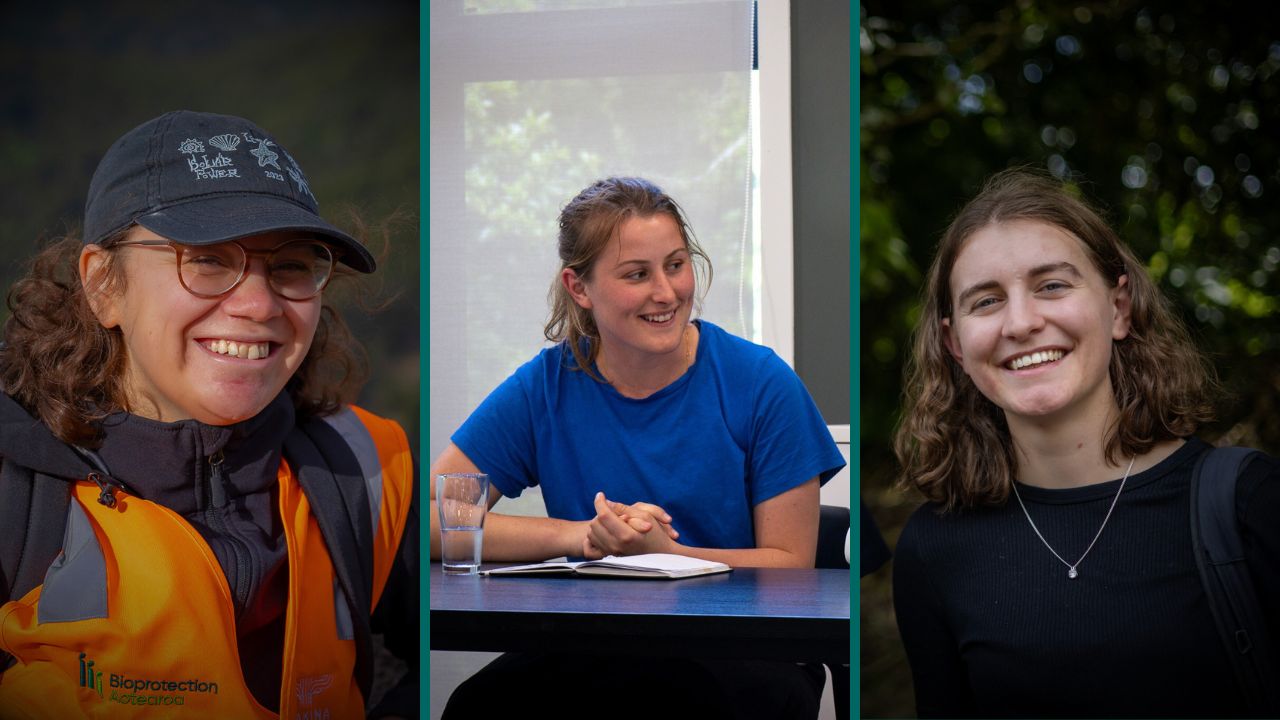
Meet the rest of the 2025 masters cohort
This Q&A is part of a series shining a light on our Masters students who have graduated in 2025. Continue the series by reading the remaining profiles and meet more of the talented graduates shaping the future of bioprotection. See what Tere Porter-Rawiri and Julia Palmer had to say about what they accomplished during their Masters and what they’re up to next.
More Information
- Research | The effects of ecological restoration on nitrogen partitioning in wetland ecosystems.
Learn more about Pearl’s research with Bioprotection Aotearoa, understanding how ecological restoration affects the partitioning of nitrogen among plant and soil pools in unrestored, restored and conserved wetland forests.
Find out more about this project >>