 Home
Home29 January 2026
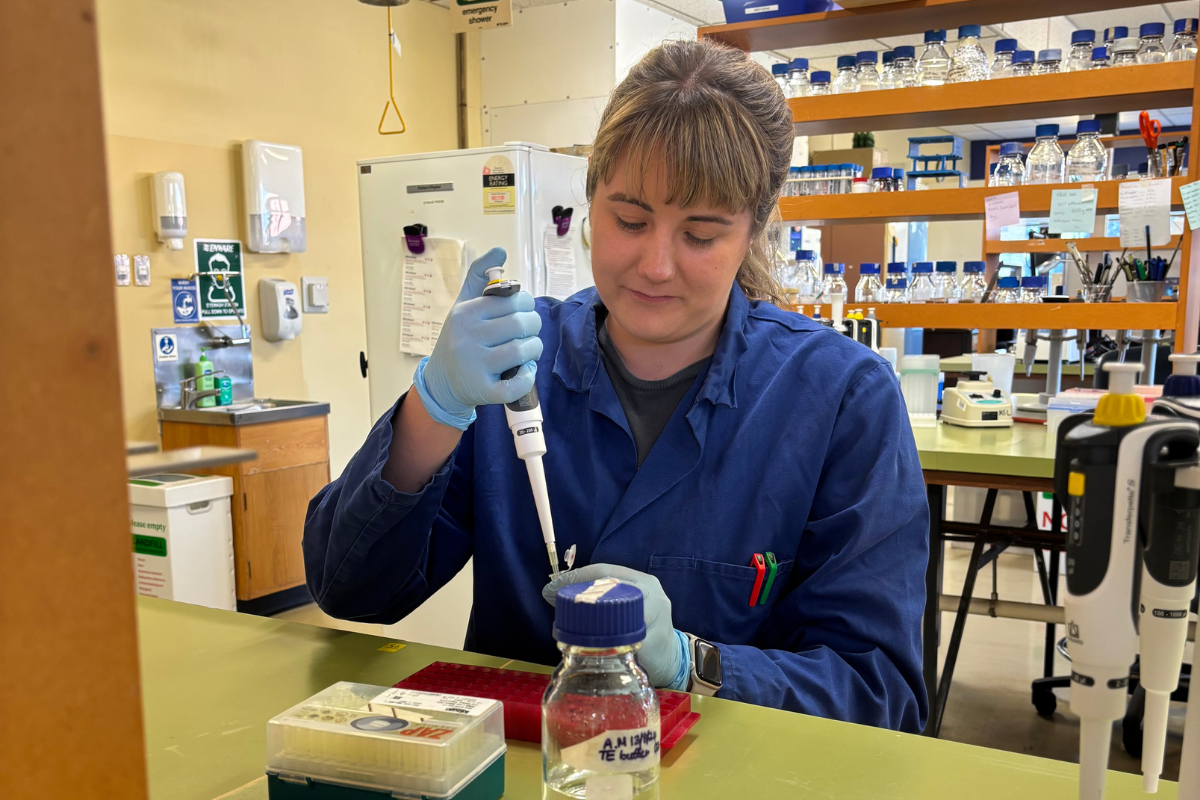
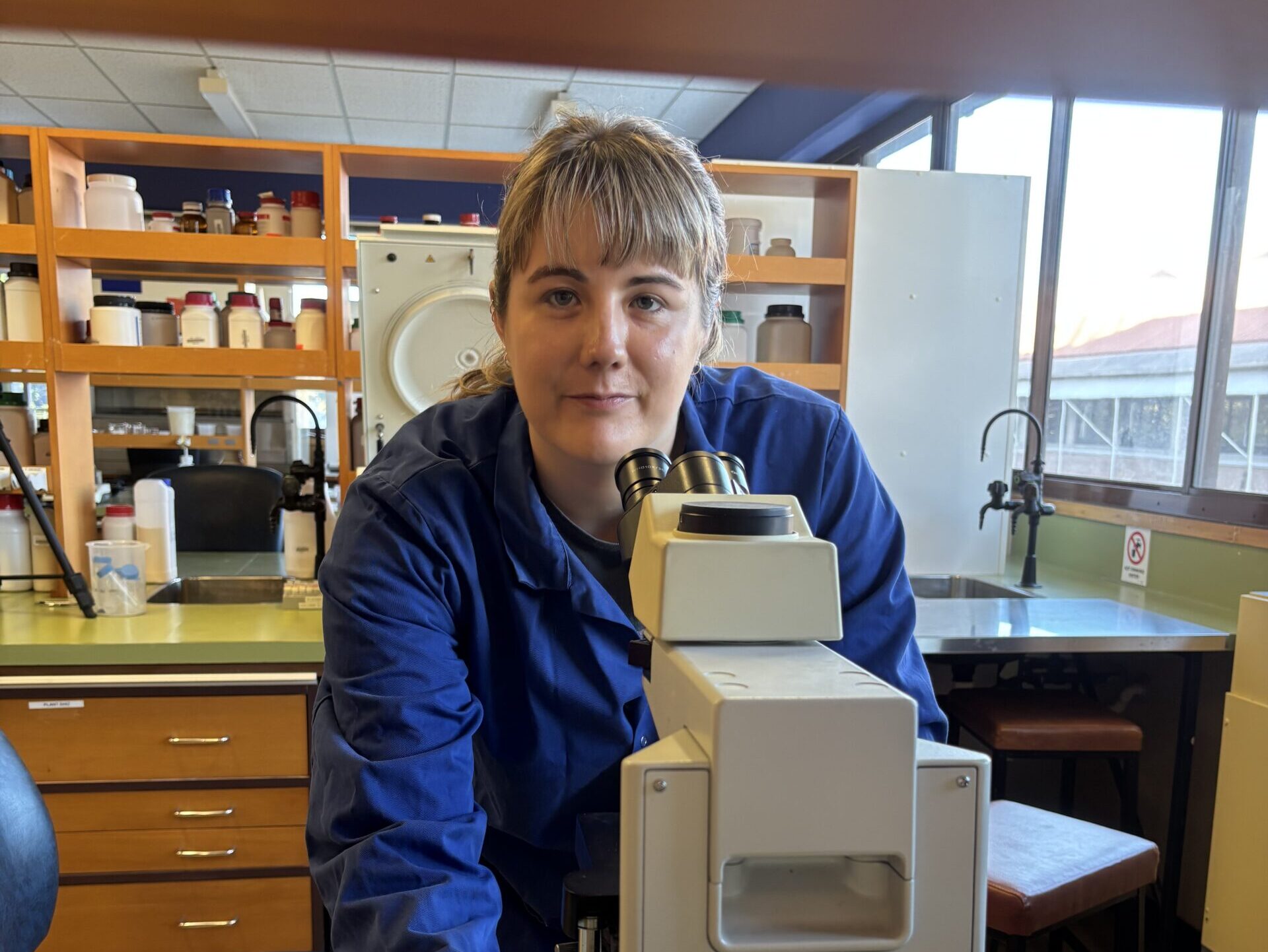
Ashleigh Mosen is one of three PhD students in her lab searching for a solution to crop loss caused by apple scab fungus.
Ashleigh Mosen has a passion for the little things in life; whether they’re fungal pathogens, their effector proteins, or altering gene expression with RNAi gene silencing technology. Luckily for our apple industry, Ashleigh is now turning her sights to Venturia inaequalis – the pathogen that causes apple scab.
Ashleigh first saw apple scab, also known as black spot, while working for Plant & Food Research (now the Bioeconomy Science Institute) after her Master’s. Born and raised in Hawke’s Bay, the topic hit close to home.
She says, “I was at the Havelock North Plant & Food site, and we worked a lot in the orchards. They were just riddled with apple scab. It can cause up to 70% production losses, so it’s quite a lot.”
Considering the apple and pear industry has just surpassed an impressive milestone, now worth $2b annually to New Zealand’s economy, the incentive to find an effective control strategy for apple scab has never been greater.
Ashleigh is one of three PhD students in her lab searching for a solution.
She says, “I’m looking specifically at the interaction between an effector protein from the fungus and a resistance protein from apple. I want to better understand how the pathogen achieves colonisation and resistance in the apple, so we can inform breeding strategies for resistance to apple scab.”
Effectors (or virulence factors) are types of proteins that can be secreted by pathogens to effectively hijack a host cell and make it easier for infection to occur.
“One of the ultimate goals,” Ashleigh says, “is to engineer apple resistance proteins to recognise the effectors secreted by the pathogen. If we can basically stack different resistance genes together, it should be able to provide durable protection for the plant and make it harder for the pathogen to overcome resistance, because it would need to overcome not one, but all, of the resistance genes.”
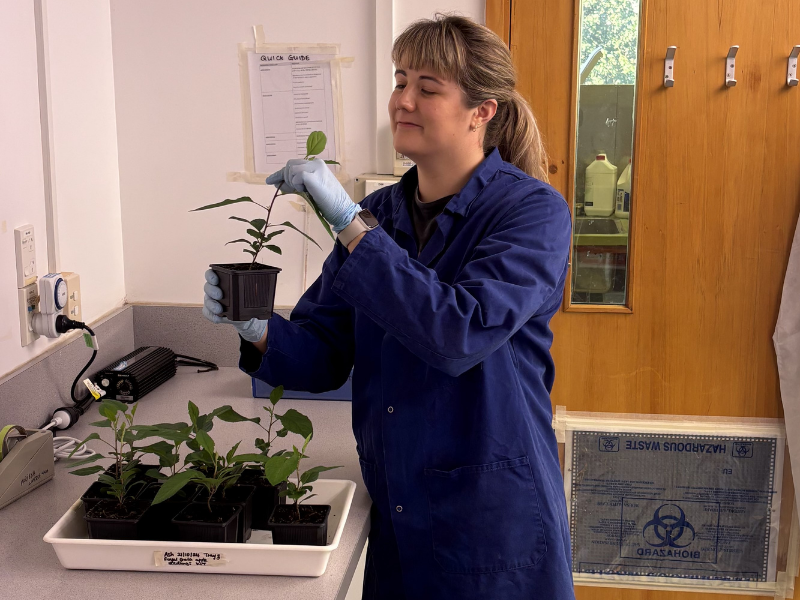
Ashleigh examines apple seedlings for infection in the lab.
Ashleigh has been looking at strains of V. inaequalis that are able to completely or partially break down resistance, and has come across a strain found in Germany that is able to overcome nine resistance genes.
She says, “I’m also going to be using CRISPR technology to try to knock out the gene encoding the effector protein in the pathogen, to see what effect it has on its virulence.”
Ashleigh’s research is co-funded by Massey University and Bioprotection Aotearoa, and overseen by a few “really awesome supervisors”: Associate Professors Carl Mesarich and Helen Fitzsimons (Massey University), and Dr Jo Bowen (Plant & Food Research/Bioeconomy Science Institute).
Carl was the same mentor who helped her create a double-stranded RNA spray for controlling a fungal pathogen of pines for her Master’s. Ashleigh also collaborated with Jo at Plant & Food Research and was taught both by Carl and Helen.
So, the bets are that the dream team is back together and should come up with something impressive!
Additional Information
- Research
To learn more about research to develop biocontrol tools against microbial threats that cause disease in plants, explore the project.