22 May 2026
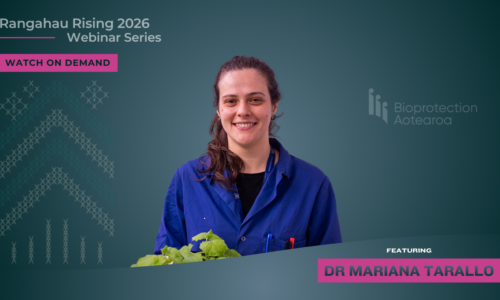
Wednesday 19 August, at 1:00 pm Register here Spiders are the dominant, most abundant, and most diverse natural enemies in agroecosystems. They are generalist predators of insect pests, comprising many…
July 22 at 1PM Register here The roots of the biosecurity system in Aotearoa trace back to the early colonial period. We may think that our biosecurity system is learning…
20 May 2026
Wednesday 16 September, at 1:00 pm More details coming soon. Please check back here for the registration link. More Information Research: Resilience Agroforestry for Pacific Communities – Exploring how agroforestry…
9 February 2026
Plant diseases are an increasing threat to natural ecosystems worldwide, and Aotearoa New Zealand is no exception. Kauri dieback, caused by the soil-borne pathogen Phytophthora agathidicida, is devastating populations of the…
Plant disease outbreaks are occurring more frequently across the world. This is due to a combination of environmental change and people moving plants, pathogens, and their vectors beyond their natural…
Few sectors are more contentious than dairy, with debates tending to be polarised between optimising the current system and “abolitionist” narratives. The ongoing intensification of dairy farming globally and in…
Bacterial pathogens infecting humans or plants have major impacts on health and agriculture, especially as the efficacy of traditional control methods such as antibiotics and agrichemicals is increasingly undermined by…
13 October 2025
Non-native plants are increasingly threatening Aotearoa New Zealand’s biodiversity and ecosystems, with nearly half of all plant species being non-native and many becoming environmental weeds with a widespread impact. To…
3 July 2025
Agricultural land use intensification is a major driver of soil carbon loss. Understanding the impacts of agricultural land use on soil carbon cycling is essential to develop sustainable land use…
2 July 2025
Microbes, the tiny living things that are found all around us, play crucial roles in the development, health and interactions of humans, animals and plants alike. The microbial communities, or…

 Home |