
 Home
Home23 February 2026
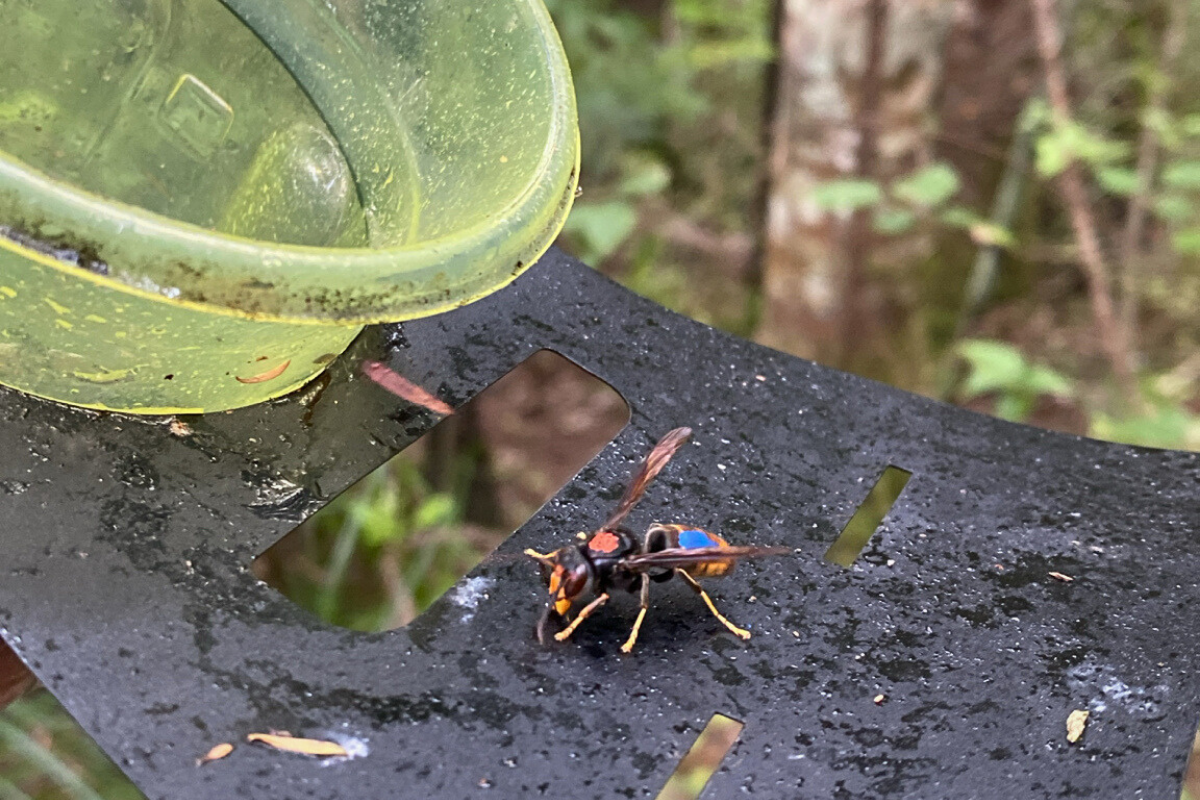
Yellow-legged hornet sighting on iNaturalist NZ Mātaki Taiao app. Photo © scottishrob, licensed under CC BY-NC 4.0.
Biological incursions are the gift that keeps on giving. One of the latest gifts is the yellow-legged hornet (Vespa velutina), discovered in Auckland in late October. This hornet is like no other invasive insect we have seen – it is predicted to be dangerous to public safety and devastating to our honeybee industry, with one yellow-legged hornet queen being able to produce 12,000–15,000 hornets in a season.
I’ve followed many reported biosecurity incursions – myrtle rust, Mycoplasma bovis, Caulerpa and the golden clams just to name a few – but the hornet wasn’t even on my radar, and I was only made aware of it when a colleague sent me a media item in early November. This revelation made me wonder – why didn’t we know more about this in advance? Why weren’t there more discussions prior to it arriving on our shores?
When I compare the yellow-legged hornet incursion to other biosecurity challenges I have been involved in, two things have stood out. First, New Zealanders seem to be suffering from issue fatigue. From my non-expert observations of the media, social media platforms, and talking to people, there definitely is concern about the incursion, but this is also mixed with feelings of detachment. Yet another incursion reported and people’s attention quickly shifts to the next issue. This particular incursion also happened right before the natural disasters we had over the holiday period. The very immediate threat to life, the recovery phases and the mourning from the losses natural disasters cause make it hard for other issues to get any headroom.
The second thing that stood out to me about this incursion was the scant and inconsistent communication from government agencies. During November and December, the critical period for surveillance, there was very little information given out from official agencies (MPI), except via a national media RNZ item which then led back to Ministry of Primary Industries website.
The website lists 3 items: fact sheets, hornet finds and ‘how to make a trap’. These aren’t bad things, in fact they are helpful, but it’s not enough to reassure those of us working in the biosecurity space or the industries and communities at risk. We have exceptional, in-country examples of what good communication looks like. Whether you agree or not with the Covid-19 responses, the clear and constant communications and streamlined messaging was a class act. We all knew as soon as we could what was happening and what our options were. A strategy like this tailored for biosecurity would go a long way towards supporting the public (not to mention our ecosystems!) during incursions.
So much was the frustration felt by members of the public and those on the ground who are looking after our pollinator industries and biodiversity, that a 2500-person petition was delivered to the Minister of Biosecurity. The basis of the petition was that people felt enough hadn’t been done in the early days. This may or may not be the case, but what is clear is that there wasn’t enough communication in those early days.
Taking a new track
Issue fatigue and inconsistent communications aren’t great combinations especially when there is such a small window of time to contain and eradicate such a serious pest. There’s a lot of discourse out there about the benefits of limiting technology and phone usage that bombard us with incessant communications that keep us perpetually distracted and disoriented, all of which contributes to fatigue. However, technology is also the main route that members of public get their news, especially about potential threats from new incursions.
Technology is a main route for information sharing that could be used more during incursions, stock photo by mihailo milovanovic.
How do we keep people aware and vigilant of the ongoing risks of biological incursions, because pests don’t take a break over the holiday season, without contributing to fatigue? How can government agencies improve their communication to members of the public to maximise our chances of eradicating these serious threats to our biological industries and biodiversity? We don’t want a repeat of the Asian paper wasp or painted apple moth, which devastated our native butterflies, and we already have a massive problem with the common and German wasps.
Way back in 2016, the government of the day released a Direction Statement for Biosecurity 2025: “Harnessing the contributions of all New Zealanders, we need to make more effective use of our assets – our people, tools, information, science and infrastructure – throughout the system.” The direction statement was an ambitious and timely piece of work, but it was shelved as soon as the next government came in. This to me is still the best attempt we had to start conversations about streamlining our responses. We have the surveillance and many of the eradication tools we need (and aren’t far off with new and more precise ones), we have the expertise, but what we don’t have is clear lines of decision-making and avenues to communicate with an action-oriented public.
If the communication strategy can be strengthened, we may have a fighting chance at successfully containing and eradicating the next new-to-Aotearoa New Zealand incursion. After all, incursions have happened before and they will happen again. Aotearoa New Zealand needs an incursion communication strategy that is inclusive and resilient in the face of competing and contributing issues like climate change, natural disasters, and political change.
Additional Information
- Timeline
The yellow-legged hornet was first discovered on October 17th 2025, a lone queen building a nest in Glenfield on Auckland’s North Shore.
On November 5th, more queens were detected and more nests were destroyed.
In December, the surveillance zone expanded from 5km to 11km radius, and by January 2026, hornet detection technology via radio tracking was being trialled.
Now, in February 2026, the use of the radio tracking is ramping up with more nests found and destroyed. Currently, the yellow-legged hornets appear to be contained within the Auckland Region.
- Report suspected sightings of hornets or their nests
MPI encourages the public to make reports:
by calling the exotic pest and disease hotline on 0800 809 966
by emailing [email protected]
online at report.mpi.govt.nz – if you use this method, select the ‘suspected yellow-legged hornet’ option from the dropdown list.
Further information and regular updates on hornet finds >>
Download: Instructions on how to make a simple trap [PDF, 833 KB]
- Bioprotection Futures
To explore research on how bioprotection is imagined and enacted in Aotearoa New Zealand to support future-ready responses, visit the project stream.
- Podcast
To learn more about the current structure of the biosecurity system and how it responds to incursions like the yellow-legged hornet, listen to episode 2 of our podcast Under the Lens.
