
 Home
Home5 September 2025
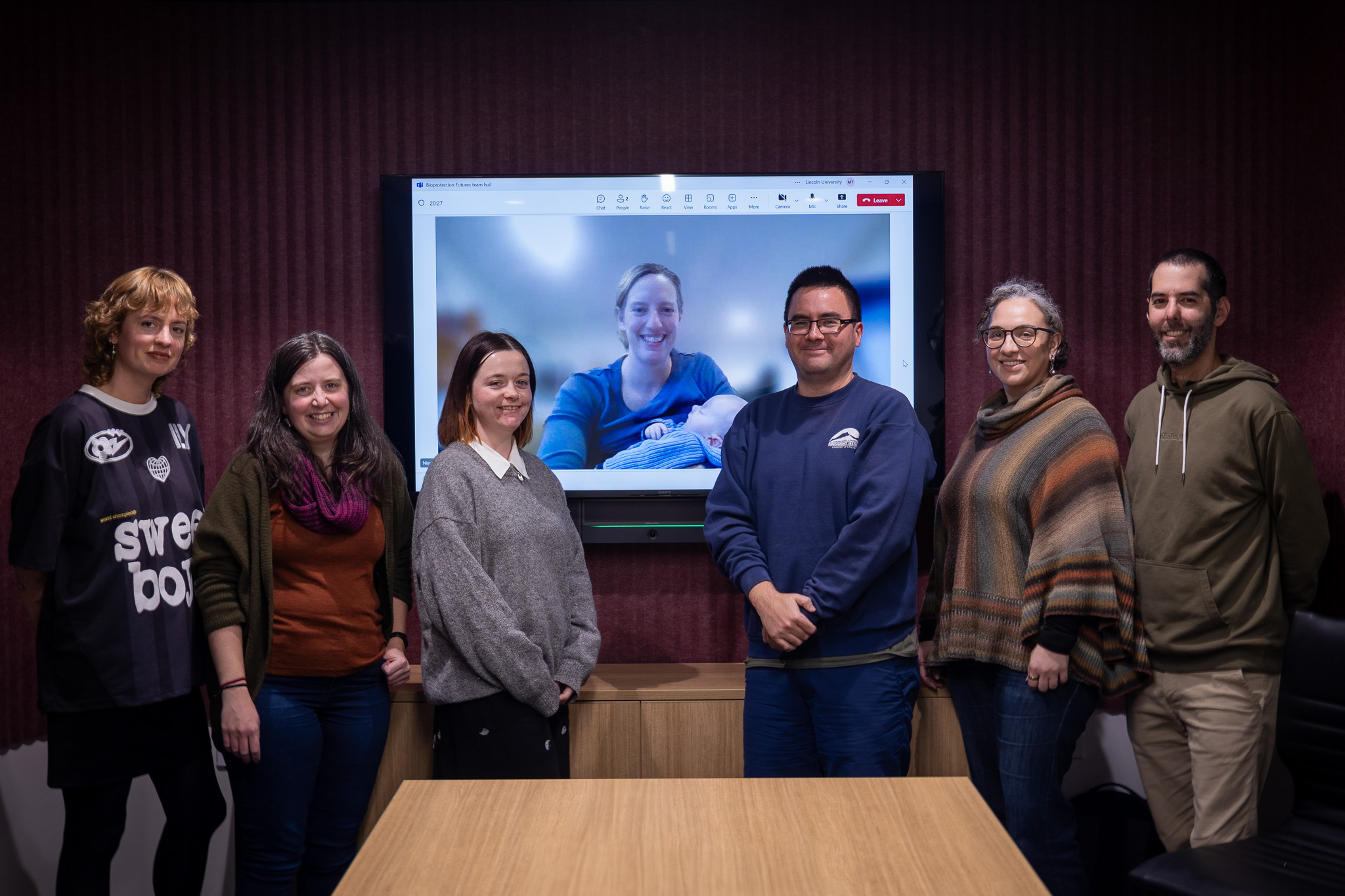
The faces behind Bioprotection Futures — bringing together expertise and passion to shape tomorrow’s solutions. From the left Dr Salene Schloffel-Armstrong, Dr Raven Cretney, Jazmynn Hodder-Swain, Dr Sylvia Nissen (on screen), Dr Marc Tadaki, Dr Aline Carrara and Dr Ramzi Tubbeh.
Bioprotection Futures (Project 1 in Pou Titirangi) is focused on understanding the social-political dimensions of bioprotection in Aotearoa New Zealand. Co-led by Dr Sylvia Nissen and Dr Marc Tadaki, our team of seven social scientists (including one PhD student) is assembled, and we are rearing to go.
In July, we gathered in person for the first time at Te Whare Wānaka o Aoraki | Lincoln University campus to map out ideas and plan ahead. With this blog post, we want to introduce who we are and our discussions of what social science in bioprotection could look like.
Who we are
Across our team we bring a range of experience, including with transdisciplinary research, practitioner knowledge, and collaboration with local communities across Aotearoa and in Latin America.
PhD candidate, Jazmynn Hodder-Swain, has worked in environmental policy in local and central government. We have two Postdoctoral Fellows: Aline Carrara has worked with land governance, Indigenous peoples and conservation groups in Brazil; Salene Schloffel-Armstrong with urban library users and advocates. Our other researchers are Ramzi Tubbeh who has worked with farmers and practitioners in Peruvian conservation and water governance, Raven Cretney with community restoration collectives across Aotearoa, Sylvia with volunteers in crisis response, and Marc with iwi and environmental practitioners on freshwater fisheries.
What drives our curiosity
All of us are social researchers, but we also bring diverse theoretical lenses to bioprotection. Our interests range from: questions of governance and the ‘how’ of decision making, to issues of power and control (political ecology), to interest in how different knowledges are produced and considered authoritative (science and technology studies), Indigenous knowledges, crisis response and resilience, and grassroots community engagement with environmental change. From this pool of skills and interests, potential directions for this project are plentiful!
Framing our research: the what, how and with whom
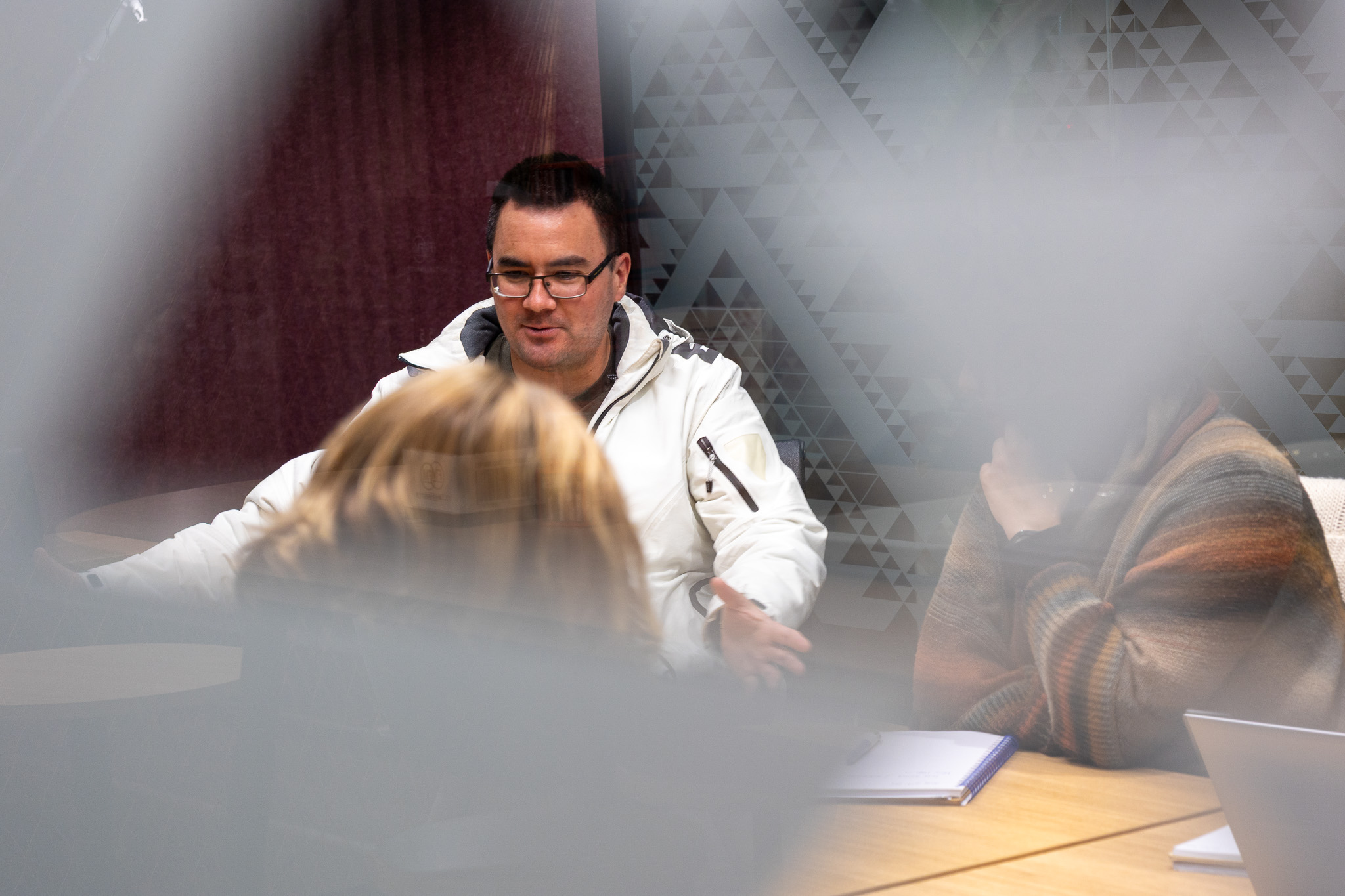
Framing the research — Bioprotection Futures co-lead Dr Marc Tadaki helps guide the team’s vision through open collaboration and shared ideas.
During our July gathering, we reflected on our varied expertise, and were pleased to identify overlaps as well as unique skillsets. We then had to confront questions of scope: how will we bound this research? Understanding the biosecurity system in Aotearoa is complex, tiered and involves multiple scales of action and multiple governance arrangements.
There are tough choices for us to make. Should we take a broader scale by looking into national policy, a regional perspective, or local community perspective? To look at a single species across space, or look at many different species in a single place? To follow the logics of policy, or the logics of those doing the mahi on the ground? Should we break the system down into component parts (e.g. pre-border, border, post-border) and look at some parts in detail? Furthermore, in doing the research itself, which people/groups do we want to spend time working with? If we want our research to help improve bioprotection, what’s our ‘theory of change’ for how we want to get there?
We also discussed our toolkit of research methods. What social science ‘data’ can we generate and analyse for our research? We mapped some of the many methodological directions we could take as social researchers, such as interviews, ethnography, policy analysis, focus groups, photo elicitation, participatory mapping, historical synthesis, surveys, critical GIS, walking methods and textual analysis. Setting out these possibilities will help us develop robust and varied understandings of bioprotection over the coming years.
To help us think about place-based issues and potential BA collaborations, we met with Phil Hulme and Laureline Rossignaud (co-leads of Project Stream 7 – Critical Pathways of Weed Invasion) to learn about their upcoming work on mapping the landscape drivers of weed spread to improve early detection and response strategies. In this generative kōrero we shared our thinking about social problems in weed management, compared research plans and discussed the possibilities of collaborating across our projects within the space of Horomaka.
What we’re exploring in the months ahead

Collaboration in action — the Bioprotection Futures team working alongside Distinguished Professor Phillip Hulme, and Dr Laureline Rossignaud from the weeds invasion project, exploring new directions in bioprotection research.
By the end of the hui we narrowed our focus and clarified next steps. We still have choices to make, but we are now enriched and empowered to work through them. More specifically, we have several streams of work progressing:
- Analysing biosecurity governance at a national level to understand ‘the system’ as it has developed over time, how it is supposed to work, and how it works in practice.
- Building a socio-environmental history of Horomaka (Banks Peninsula) as a unique case study to help us grasp what is at stake here, to give us a foundation from which to understand the historical context of specific, in-place biosecurity issues, and to illustrate Horomaka’s intersection with a myriad of governance issues both at regional and national scales.
- A fortnightly reading group for us to collectively engage with cutting edge social research on biosecurity and extend our own work from it.
Stay with us, there is plenty more to come
We came away from our hui energised for the contribution we can make as a team. Our project looks to the future of bioprotection and novel approaches that can help us meet the challenges ahead. To do that, a key focus for us is providing much-needed systematic analysis of how bioprotection is currently managed, spanning levels from the local to national, and encompassing top-down processes and bottom-up community-led initiatives.
We need to look back to look forward, to examine how bioprotection systems have developed over time so that we can identify how it could be made differently. In early October, we’ll reconvene again to share the findings of our initial analysis and further refine our direction.
Follow our updates here over the next months as our project progresses!
More Information
Bioprotection Futures
This post is part of a broader piece of work looking at the relationships between people, knowledge, and the environment.