15 December 2022
READ THE FULL NEWSLETTER HERE Sign up below to get our latest Panui with updates on news, events, and opportunities delivered straight to your inbox.
14 December 2022
Descending from across Aotearoa, members of Bioprotection Aotearoa (BA) gathered before the gates of Ōnuku Marae, Akaroa, to participate in our inaugural Noho Marae. Through the playful sounds of the…
13 December 2022
After a long and challenging year, Bioprotection Aotearoa (BA) has been given many reasons to celebrate during this last quarter of 2022. Four researchers have been awarded a collection of…
8 December 2022
Nine students have been placed across Aotearoa to kick start their summer internship with Bioprotection Aotearoa (BA), participating in research and gaining practical experiences and skills. Their journey began with…
30 November 2022
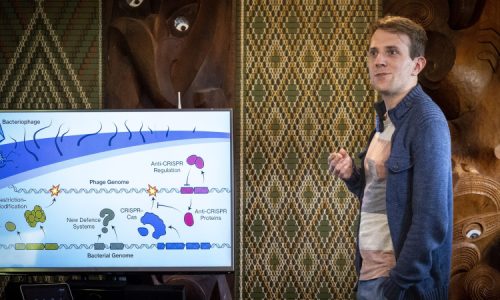
This year has been a big one for molecular microbiologist and Postdoctoral Fellow at Bioprotection Aotearoa, Nils Birkholz. Highlights include publishing four papers in high-impact journals and presenting at two…
29 November 2022
Soil microbes are central to life on Earth. They recycle nutrients, regulate water quality, support plant productivity, and sequester carbon. However, the microbes in soil change in response to disturbances,…
4 October 2022
3 October 2022
Te manu e kai ana i te miro, nōna te ngahere; te manu e kai ana i te mātauranga nōna te ao. Bioprotection Aotearoa is committed to establishing opportunities that…
Te Kaha is a quiet coastal town located in the Eastern Bay of Plenty and is one of three focus regions of scientific research for Bioprotection Aotearoa. Te Kaha 15b…
28 September 2022
The new National Policy Statement for Highly Productive Land (NPS-HPL), was released by the Ministry for the Environment (MfE) in September 2022. The intent of this policy is to ensure…
In August 2022 The Ministry for the Environment opened up a consultation process seeking feedback to retain or amend the application of the Resources Management (National Environmental Standards) for Freshwater…
25 September 2022
Kauri dieback is the common term for the disease that is killing kauri trees here in Aotearoa New Zealand. The scientific name for the pathogen that causes the disease is Phytophthora agathidicida….

 Home
Home