
 Home
Home6 August 2025

Author Jazmynn Hodder-Swain on the banks of the braids of Rakaia, where the stories shared began to sink in.
We often think of braided rivers as physical matter and hydraulic force, with gravel-filled channels shifting their way downstream and across the braidplain, occasionally bursting their banks and washing bridges and farmland away. Braided rivers certainly act as physical structures and watery processes – but they are also spaces of unique and important terrestrial biodiversity, and this aspect merits much more attention and investment.
For example, braided rivers – and the (however-temporary) islands they create – support some of Aotearoa New Zealand’s most endangered birds, such as the tarāpuka/black-billed gull and tarapirohe/black-fronted tern. Their needs are unique, their plight needs our attention, and their ecosystems need work.
Attending the Braided Rivers seminar on 7 July at Lincoln University, I was surprised to learn about the diverse array of plants and animals that rely on braided river islands as terrestrial habitat.
The annual Braided Rivers Seminar is organised by BRaid, a charitable trust that facilitates partnerships to support braided river ecosystems. Over the day, 16 speakers from central and local government, NGOs, universities, private organisations and the community came together to share and discuss the importance of braided river systems and their management.
To open the seminar, Chair of Environment Canterbury, Craig Pauling presented ECan’s current work on a 100-year braided river revival strategy. Chair Pauling noted that though historically braided rivers often acted as the boundaries between district councils, he held hope that “our braided rivers should bring us together”. Strategies are being developed for each braided river in Waitaha/Canterbury using a ki uta ki tai (from the source of the river in the mountains to where the river enters the sea) approach, in which actions will focus on reviving the mauri of the system. More information about Environment Canterbury’s braided river revival work can be found here: Braided River Revival/Whakahaumanu Ngā Awa ā Pākihi | Environment Canterbury
Key Insights
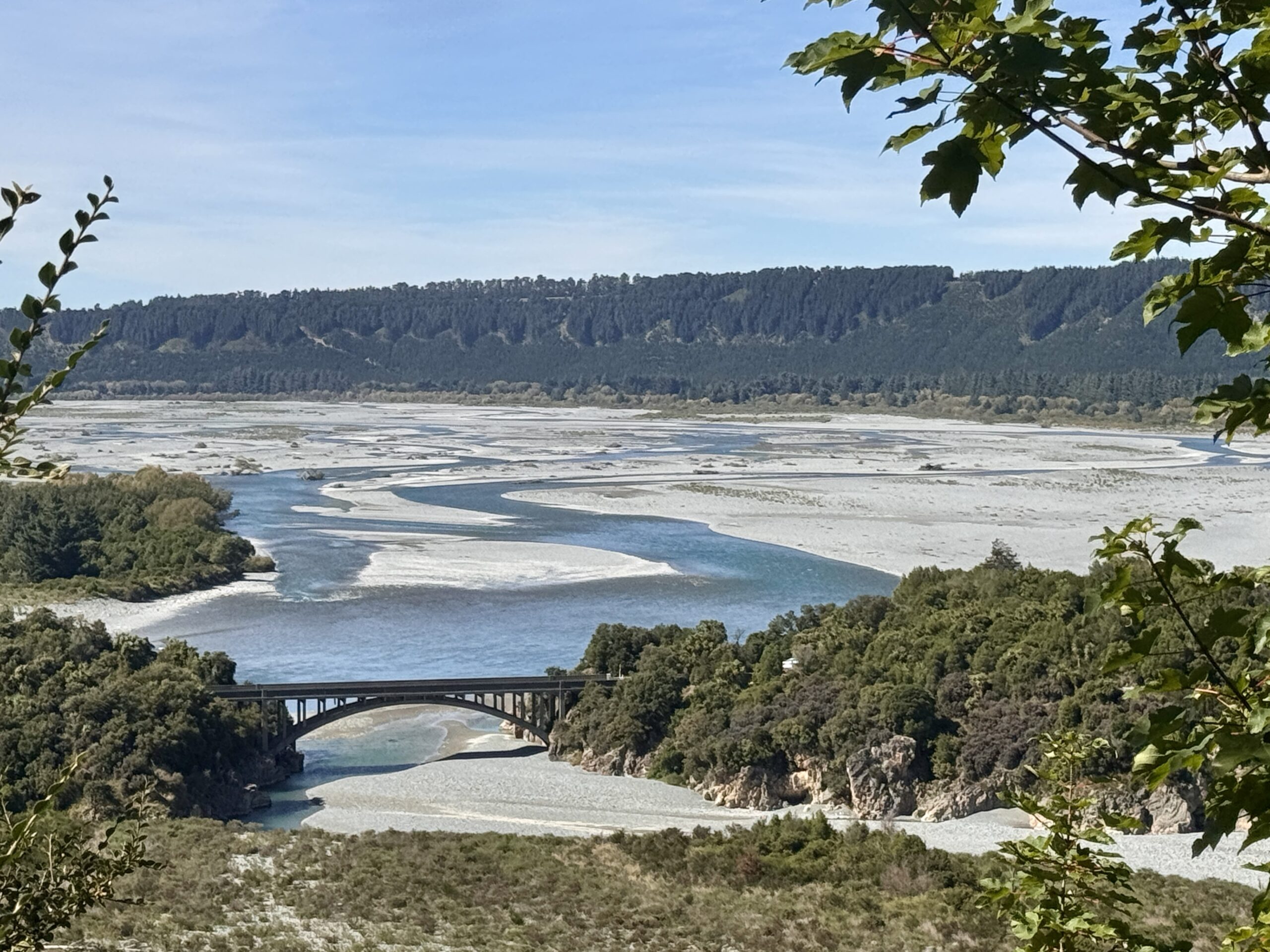
The true scale of the Rakaia River’s braided form comes into view, a landscape constantly shaped by flow and change.
With the vision of restoring the mauri of Waitaha/Canterbury’s braided river systems in mind, I wanted to share some of my take-home lessons from the day:
A lot of people really care about braided river ecosystems!
The day’s speakers were passionate about their contribution to the enhancement of braided river ecosystems, and appreciative of others providing support and collaboration. A range of people are involved in ecosystem management on braided rivers – central government employees, volunteers, mana whenua, councils, non-government organisations, locals.
Braided rivers are especially important for some birds.
Some of Aotearoa New Zealand’s declining endemic and native bird species – as well as nationally endangered, critical and vulnerable species – rely solely on braided river systems for nesting and feeding. Many of these birds rely on South Island braided rivers specifically for nesting, meaning these are critical, irreplaceable habitats. Protecting this life means protecting these places – there is no possible substitution.
Feral cats are a real problem for braided river birds.
They predate on birds at all life stages: eggs, chicks and adults. Biz Bell (Managing Director, Wildlife Management International) shared how a single feral cat devasted a tarapirohe/black-fronted tern colony at Bridge Island on the Waiau Toa/Clarence River over one breeding season, completely killing all eggs and chicks.
The Department of Conservation found that controlling rabbits in the Tasman Valley led to a reduction in feral cats, and they are hoping this trend will continue. Reduced rabbit numbers has also led to a rapid recovery in vegetation, highlighting that pest management of one species can have affects for other species.
There are a lot of willows along our braided river systems, which have a range of values and impacts.
The roots of willow trees slow down floodwaters and reduce erosion, plants growing on bars can nurture honeybees, and trees provide structure shade for fish. However, willows also require a lot of water, invade biodiversity and constrict the braids in braided rivers. Removal of willows can increase channels and gravels in braided rivers, as well as increase habitat for aquatic species. Wilding willows are difficult to manage as there are only two willow species on the unwanted organisms list although there are at least 57 species of willow naturalised in Aotearoa New Zealand. There are a lack of regulatory levers that can be pulled to control the remaining 55 willow species.
Many other species also dwell in braided river ecosystems, for better or worse.
Species include Norway rats, lupins, black-backed gulls, stoats, hedgehogs, ferrets, harriers, broom, and gorse. Dean Nelson (Senior Ranger Biodiversity, Department of Conservation) also mentioned that tarapukā/black-billed gulls have been found to predate on tarapirohe/black-fronted tern eggs and chicks in the Tasman Valley from time-to-time, which is an issue as tarapukā are declining and tarapirohe are nationally endangered. Braided rivers host a significant diversity of terrestrial life, with unique dynamics and outcomes of concern for conservation.
Weed identification and control, and the monitoring of bird nests are supported by technology.
Drones can use artificial intelligence to identify pest weeds, which spray drones and ground crews can then go and spray. Cameras near bird nests can verify causes of death. Technology is changing what is considered possible for pest identification and management.
Vegetation identification in braided rivers is important.
Taxonomy identified in the Department of Conservation’s case study in the Waitaki River has shown that barren looking landscapes can have an abundance of invertebrates! 900 taxonomic units of invertebrates were found in one study site, the Cushion Fields. Although braided rivers can appear to be barren landscapes, they are abundant with life.
A range of human actions can help support the revival of endangered bird species.
This includes limiting human disturbance like recreational vehicles, though Grant Davey (Ashley Rakahuri Rivercare Group) said “Human disturbance is easy. Habitat, floods and weeds are worse”. Conservation interventions mentioned through the day included trapping, shooting, hand clearing and machine clearing of weeds, shelters for chicks, scouring of the river and island enhancement, poisoning, dogs, drone and airplane spraying, and mulching. Such human intervention or ecological ‘tinkering’ for conservation involves a lot of trial and error, and in some cases, produces unexpected results. For instance, in some cases nesting has proved to be more successful in parts of braided river systems without any human intervention.
Partnership with mana whenua will be crucial for braided river revival strategies in Waitaha/Canterbury. As a part of this, it will be important to get mana whenua perspectives on the above issues and pest management options.
Final Thoughts
“This seminar opened my eyes to the many species that interact with our braided river ecosystems and how they can enhance or degrade values, mana (strength) and mauri (life force) of these spaces. When thinking of braided rivers as physical, flowing matters, the temptation may be to think that all they need is room to move.”
Whilst this is certainly valuable, this seminar highlighted that restoring the mauri of braided rivers requires a holistic approach that includes attention to what lives on the islands and along the riparian margins. It was inspiring to hear how much care and dedication the speakers put towards the management and protection of braided rivers. If we don’t act, the mana and mauri of our braided rivers will remain degraded, and the life force could shrink further. I am looking forward to following along and seeing how the braided river revival strategy rises to the challenge of restoring the mauri of our braided rivers in Waitaha/Canterbury.
More Information
Learn more about braided rivers, biodiversity, or restoration efforts.
Recordings of talks and PDFs of slides are available here:
2025 Seminar presentations – Braided Rivers New Zealand
Bioprotection Futures
This post is part of a broader piece of work looking at the relationships between people, knowledge, and the environment.