
 Home
Home21 August 2025

Measuring up! This isn’t your garden snail. The southern Powelliphanta augusta is one of Aotearoa’s giant carnivorous snails, showing off its striking shell colours. 📸 Genomics Aotearoa
You may have recently read about the Department of Conservation spending around $100,000 per year for the past 4 years to house and manage snails. Now, these aren’t just any snails, they are the endangered southern Powelliphanta augusta snails to be precise. Still, this may have had you questioning why. Why do we need to house snails instead of releasing them back into their habitat? Why would our government spend money keeping these animals in a refrigerated Noah’s ark that appears doomed no matter what interventions are offered up? Especially in a time when we have so many other competing and urgent issues this seems a strange and even pointless activity to some.
These “why” questions wouldn’t even be on our lips if snails were universally considered to be cute and cuddly. As a species, humans would do anything to protect a cuddly koala or a stunningly sleek cheetah. The term charismatic fauna, or flagship species, came about as a strategy that conservationists in the 1980’s were banking on as a major push to save endangered species. But in Aotearoa, we don’t have megafauna like koala and cheetah to lean our conservation movements on. Our closest species in this category is the very endearing kākāpō. Its cute, green whiskery face can naturally charm and inspire.
Charismatic fauna get people through the conservation door, but we want them to leave with a love for all our other taonga fauna. This won’t happen without considerable effort. Behavioural psychology tells us that we make decisions in two main ways – fast thinking, which is intuitive (like falling in love with cute fluffy faces), and slow thinking, which takes cognitive energy (looking past the slime to recognise some intrinsic value). So, let’s take the time and energy right here right now to understand these snails and their plight.
The snail saga
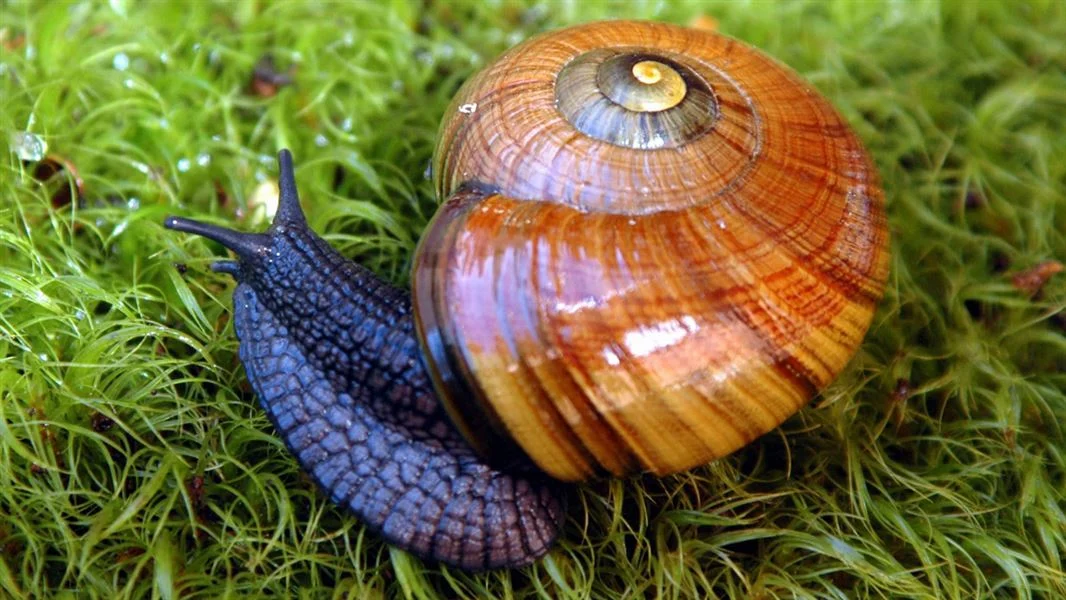
Nature’s artwork in motion. The colours of the southern Powelliphanta augusta stand out against the wild backdrop as captured by Kath Walker for the Department of Conservation (DOC)
The southern Powelliphanta augusta snail is a giant in the snail world. A carnivorous snail that can grow to the size of a fist, they are one of many native snail species that are endemic to Aotearoa New Zealand and have unique biology. In fact, Aotearoa New Zealand is an international biodiversity hotspot for land snails. We have lots of tiny ones, many of which haven’t been described, and a few astounding big ones. These giants are unusually coloured with stripes and spots of browns, greys and yellows, and they live in our native wet high-country forests and swamps. And there is nothing like them in the world.
The southern Powelliphanta augusta lived on a remote mountain in Westland, Mt Augustus. A few years ago, a coal mining company decided that Mt Augustus was a perfect spot for an open-cast coal mine and decided to dig it up. On it becoming clear that the snails living there were a unique species, and possibly 3 unique species, it was decided that all the snails affected would be gathered up and brought into captivity. The company agreed to restore the habitat and reintroduce the snails when they were finished.
Unfortunately, biology doesn’t aways work the way people want it to.
After extracting the coal and getting paid, the mining company put the snails back, but they could no longer survive in the newly altered habitat for reasons that are not clear and may never be. Biology and ecosystems are like that, complex, difficult and sometimes inexplicable. We do know the new habitat grew more weeds than native plants, and just like an ill-fated movie plot where the characters destinies are predetermined to end tragically, things did not work out for our snails.
This left a degrading environment on an ex-coal mine site that now had a layer of mostly unfamiliar vegetation and all the giant carnivorous snails in a couple of fridges. The mining company agreed to keep paying to look after the snails, but soon went out of business, leaving the government to pick up the bill.
With a politically motivated argument for not spending money on these animals having brought about a conversation on priorities (again driven by values (poverty vs conservation) and perceptions (cute vs slimy), what do we choose and where are our values aligning?
Do we let a unique and poorly understood species die out? Or keep them in a fridge forever? Remember, these snails are unique. They are as representative of Aotearoa New Zealand’s unique evolutionary history as the charismatic kākāpō, fantastical prehistoric moa or our cultural symbol, the kiwi. They may have properties that could help us with novel health treatments, anti-aging properties, materials, or antibacterial agents. These snails might be the keystone species, like our magnificent kauri trees that holds these unique environments together. We don’t know. No one has ever done the research. Though at the moment, researchers are working on the genetic analysis of the remaining population, to ensure we are managing the remaining snails in the best and most effective way. Of many outcomes, the results may help us find them a new home.
There is one thing we do know – a billion years ago lived a species that was the common ancestor of us and these snails. What right do we have to deliberately let a species that is older than us, go extinct? Especially when it’s due to deliberate human actions that they are homeless. This is a particularly relevant point now, given the ; why are we intent on spending resources bringing back something that’s been lost and yet debate protecting something we still have?
This is their plight. And this explanation of their plight may be compelling for some. But we worry that others might still not be moved. How can we get more people to champion our giant snails? How can we give them the charismatic pull of the kākāpō?
Creating charismatic champions

Casual snail appreciation session with Professor Peter Dearden (Genomics Aotearoa). Because who wouldn’t stop to admire a Powelliphanta augusta? 📸 Genomics Aotearoa
One strategy to make them more relatable is to anthropomorphise them. Anthropomorphising a snail has been achieved by the DreamWorks Animation creators of a 2013 movie that centred around a plain garden snail named Turbo. We root for Turbo as he pursues his dream of winning the Indianapolis 500. Even earlier than this, there was the legendary Gen X movie the Neverending Story. The movie had a memorable and whimsical racing snail ridden by a character named Teeny Weeny whose mission was to travel across Fantasia to inform the Empress of the impending ‘nothingness’. This movie with its themes of imagination, hope, and perseverance balanced with darker elements and existential threat of “the Nothing” was etched into the minds of any child that watched it. Movies like these prove that humans are capable of empathising with even the most unlikely sources for character heroes (like the salad eating racing snail) depending on how they are portrayed.
Aside from movie making, anthropomorphising helps tell the conservation story. It helps show the interconnectedness of evolution, habitat loss, climate change, and trade and consumption. Anthropomorphising can help tell a story that makes these overwhelming themes manageable and even hopeful.
We hope more people decide to support our snails, and all our less charismatic taonga. Saving this species isn’t meant to compete with or diminish the existing crises that we are facing. Caring for the uncharismatic also speaks to the powerful sentiment that society is judged by how it treats its most vulnerable and marginalised. Possibly no species is more marginalised as one that clinging to existence in a fridge. The fact that we are supporting these less charismatic species at all points to an intact (if not challenged and a bit wobbly) societal moral compass that we should not lose sight of.
We just need to remind ourselves that while we seem to know the price of everything, we seem to be less knowledgeable about the value of anything. And everything has value, it just depends on how you look at it.
More Information
- Earlier insights and opinions from our Director
De-extinction is a fairytale, not a substitute for conservation
In that earlier opinion piece, Amanda Black, with guest contributors Peter Dearden and Thomas Buckley, argued that de-extinction—while captivating—distracts from urgent conservation needs…

